CVS Email Offered 50% Off Memberships, But It’s Full Price Online 1:25 AM (17 hours ago)
CVS just sent out a sensational year-end promotion via email for CVS ExtraCare Plus — its premium loyalty program — promising customers a $10 monthly bonus reward for a year and it would only cost $2 a month.

Whatta deal — pay $2 a month and get $10 off every month!
CVS maintains two types of loyalty programs. The most common is CVS ExtraCare – a free card with a barcode that most of us have. The other is called CVS ExtraCare Plus – which is a $48 a year program that provides extra benefits, including 20% off on full price CVS brand products, free delivery and shipping, and a $10 monthly credit on purchases.
Since MrConsumer had planned to feature this offer in Consumer World as the “Bargain of the Week,” he tested the promotion on the CVS website to ensure it was giving customers what it promised.
*MOUSE PRINT:

To his surprise, the screen on which customers would finalize the purchase of the plan for a year was charging the full price — $48.
We immediately contacted CVS’ PR folks to alert them to the issue and get an explanation. And the answer was, where else, lurking in the fine print:
*MOUSE PRINT:

So you have to be a first-time “plus” member, and enroll in person in the store. The company could have made it a lot easier for customers if they simply issued a promo code that could be entered on the CVS website in order to get the half off deal.


TSA’s New $45 Fee for Improper Travel ID Is More Than Double Original Fee 8 Dec 1:30 AM (7 days ago)
On December first, the Transportation Security Administration (TSA) announced that starting on February first, any passenger who presents themselves at an airport check-in and does not have a Real ID drivers’ license, passport, or other acceptable form of identification will be charged a new $45 fee. As you will see, a mere 10 days earlier the TSA formally set the fee at just $18.
That fee is to use a modernized alternative identity verification system, called TSA Confirm.ID. If the passenger goes through the process successfully, they will in essence be cleared for air travel but only for a period of 10 days.
In checking on the process that the TSA used to authorize this new fee, MrConsumer looked at the Federal Register where official notices are published. There, as of December 3, the only notice he found was dated November 20, 2025 entitled, “TSA Modernized Alternative Identity Verification User Fee.”
*MOUSE PRINT:

It said the fee was $18, not $45. Referring to the $18 fee, the Federal Register notice indicated:
When setting fees for services, TSA adheres to Federal policy, including policy outlined in the Office of Management and Budget Circular A-25, dated July 8, 1993, regarding user charges. In summary, the circular provides information regarding the basis upon which user charges are to be established and implemented.
TSA has compiled a fee development report that provides a detailed discussion of the modernized alternative identity verification program’s expected costs, expected population, and fee determination. A copy of the fee development report can be accessed at TSA.gov.
So this says they did detailed calculations to come up the $18 price. We could not find that report on the TSA website.
Then, less than an hour after we first checked the Federal Register on December 3, the TSA filed another notice there saying they recalculated the fee, and that it was now $45:
*MOUSE PRINT:
TSA is updating the fee associated with the TSA Confirm.ID based on review and revision of relevant population estimates and costs. The Fee Report now includes a revised estimate of the population likely to use the TSA Confirm.ID program, the impact of the fee on individuals’ decisions to obtain an AFOID instead of paying the fee and TSA’s implementation costs, which affect the total fee necessary to recover the costs of the program. Using the updated estimates and a revised methodology that accounts for usage rates based on similar historical and implementation trends, TSA recalculated overall costs and determined that the fee necessary to cover the costs of the TSA Confirm.ID program is slightly more than $45.00.
And like the original fee justification report, we could not find the new report on the TSA website as promised either.
Last week, we sent the TSA some pointed questions about the huge increase in the fees, including asking for an explanation of how the price of their new ID service jumped from $18 to $45 in just 10 days, and to provide copies of both fee development reports that were missing from their website. We did not hear back.
But late in the day on December 4, an ID fairness organization reported that the TSA finally posted the fee development reports on the TSA website.
*MOUSE PRINT:
The November report estimated the program would cost $1.12-billion and would serve 65.3 million passengers over five years. Their December report, however, estimated the five-year cost at $475.7-mllion and that only 10.6 million passengers would utilize it.
The industrious among you are free to analyze both reports to see if the TSA has fairly evaluated the anticipated costs and usage.
Amazon Sued Over Fake Sale Markdowns 1 Dec 1:40 AM (14 days ago)
Two consumers recently sued Amazon over fake discounts advertised during Prime Day this past July.
They allege that big percentage discounts are offered off of fake list prices to make shoppers think they are saving a bundle. In fact, the lawsuit asserts, that the savings are often far less than claimed, that the same sale price had been offered previously, or that Amazon never charged that stated list price in the previous 90 days.
As an example, the complaint says this headphone was supposedly 44% off:

The consumers’ lawyers contend:
But, in fact, Amazon does not deliver the promised 44% off because it uses a Fake Prior Amazon Price in calculating 44% supposed savings. While Amazon lists a Fake Prior Amazon Price of $134.99, in fact, these Skullcandy headphones have often been offered at the same “sale” price during the past 90 days, and never cost more than $110. … As the headphones were never offered on Amazon for the fake strike through price of $134.99, a customer buying these headphones during Prime Day 2025 overpaid because Amazon did not deliver the 44% savings it promised.
MrConsumer checked CamelCamelCamel.com and in fact that headset was offered at the full $134.99 price for about 10 separate days in the first half of 2025.
Amazon has made some modest strides in explaining what it means by “list price” in its product listings. That almost invisible little “i” reveals their definition.
*MOUSE PRINT:

And you can see Amazon’s own price history chart by clicking the Rufus button at the top left of the screen.
That said, for many years, Amazon and others have used exaggerated or rarely charged list prices to give shoppers a false sense of the savings being advertised and the product’s value.
It may be a while before this case proceeds because the judge placed a temporary hold on the proceedings while a similar case is being heard in a Washington appeals court.
Delta and United Sued Over Window Seats Without Windows 24 Nov 1:15 AM (21 days ago)
In August, consumers filed two class action lawsuits — one against Delta and the other against United Airlines — for charging premium prices for window seats that did not have windows adjacent to them.

In the complaint against Delta, the consumer’s lawyer contends:
For many years Delta has knowingly and routinely sold windowless window seats to travelers. For instance various models of Delta’s Boeing 737 Boeing 757 and Airbus A321 aircraft are built with one or more seats that would traditionally have window but do not include one due to the placement of air conditioning ducts electrical conduits or other interior components. Delta operates hundreds of these planes which each make multiple flights every day. As result Delta has likely sold over million windowless window seats throughout the class period.
This poor consumer who brought the case, the complaint says, spent four-and-a-half hours on his flight from Atlanta to Orange County, California seated against a blank wall.
Apparently other airlines like American and Alaska that sell windowless window seats provide a warning during the reservation process disclosing that those seats have no actual window.
*MOUSE PRINT:

In the United Airlines case, lawyers for the airline are asking that the case be dismissed, arguing that “window” refers to the position of the seat and not any potential view from that seat, saying in part:
“The use of the word ‘window’ in reference to a particular seat cannot reasonably be interpreted as a promise that the seat will have an exterior window view.
Rather, the word ‘window’ identifies the position of the seat — i.e., next to the wall of the main body of the aircraft.”
United’s lawyers also made a very clever argument when they asserted that the airline’s contract of carriage — the formal agreement between the airline and passengers — “does not contain any promise that seats in the window position of any aircraft will have exterior window views.”
*MOUSE PRINT:
We scoured their contract of carriage and in fact there is no disclosure at all in reference to window seats having or not having a view. There is also nothing in the contract of carriage that guarantees you won’t be sucked into the airplane’s toilet and be ejected from the plane somewhere over Kansas!
Safe travels. Happy Thanksgiving to all our loyal readers.
P.S. You can visit Aero Lopa to see window placements and seat maps for most major airplanes and carriers.
Walmart Thanksgiving Prices Way Down??? 17 Nov 1:43 AM (28 days ago)
To hear Walmart tell it, food prices for Thanksgiving are way down.
Every year Walmart posts a shopping list of common groceries that one would buy to prepare a full Thanksgiving meal for a large family. For 2025, they are touting a dinner for 10 will cost less than $4 a person, for turkey, cranberry sauce, and all the fixings.
Last year, the price was close to $7 a person. Wow, are we living in a world of grocery prices crashing all of a sudden?
Not quite.
*MOUSE PRINT:
Here is Walmart’s grocery list for their 2024 and 2025 Thanksgiving dinner side by side.
Walmart Thanksgiving Dinner
Shopping List
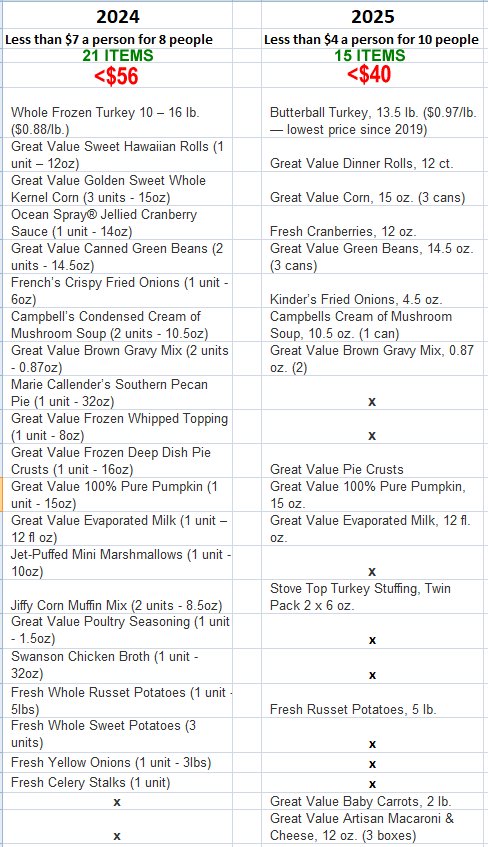
For 2025, Walmart dropped a net total of six items from their shopping list, including a number of fresh vegetables, and a large southern pecan pie. In their press release FAQ section, they clue you in to the little trick they pulled.
*MOUSE PRINT:
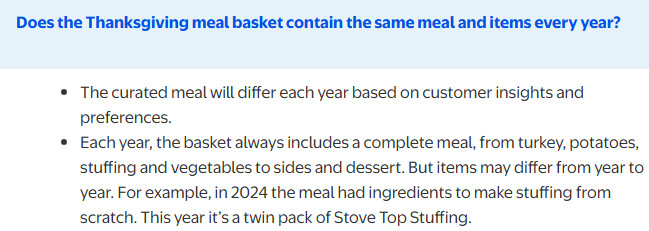
Of course, most people don’t design their Thanksgiving dinner around Walmart’s suggested menu, so your costs are likely to be much higher.