PACT Announces Two New Members to Its Board of Directors 18 Dec 8:07 AM (yesterday, 8:07 am)
Philadelphia, PA — PACT, the Philadelphia Alliance for Capital and Technologies, is pleased to announce the appointment of Kyle Carlson, CFP®, Portfolio and Commercialization Manager at SEI Ventures, and Keyur Parikh, Senior Director of Workplace Technologies at Vanguard, to its Board of Directors.
These new appointments strengthen PACT’s leadership as the organization continues to advance innovation, investment, and growth across Greater Philadelphia’s technology, healthcare, and life sciences ecosystem.
Welcoming Kyle Carlson to PACT’s Board of Directors
Kyle Carlson currently serves as Portfolio and Commercialization Manager at SEI Ventures, the corporate venture capital arm of SEI Investments. In this role, he oversees and optimizes SEI’s investments in early-stage companies, supporting founders as they scale innovative solutions across financial services and enterprise technology.
Kyle has been with SEI for three years and previously served as a Director in SEI’s Asset Management Division, where he led a business intelligence and strategy team focused on data-driven decision-making and growth initiatives.

Prior to joining SEI, Kyle held corporate development and strategy roles at Vanguard and served as an Officer in the United States Army, bringing a strong foundation in leadership, operational discipline, and strategic execution.
He earned an MBA from the University of Notre Dame and a Bachelor of Science from the United States Military Academy at West Point.
Welcoming Keyur Parikh to PACT’s Board of Directors
Keyur Parikh is a Senior Director of Workplace Technologies at Vanguard, where he leads technology delivery and strategy for Vanguard’s Workplace Solutions (VWS) business. His portfolio supports business-to-business sponsor platforms, operations, data, and architecture functions across the firm’s retirement and recordkeeping services.

Keyur plays a key role in advancing innovation and artificial intelligence initiatives, building scalable and forward-looking capabilities that strengthen Vanguard’s competitive advantage and support long-term growth.
Throughout his tenure at Vanguard, Keyur has held several leadership roles, including developing digital advice platforms for retail and financial advisory clients, leading shared services organizations supporting global functions, modernizing enterprise trading platforms, and spearheading the Unified Communications and Collaboration (UCC) program to streamline and integrate tools across the organization.
He began his career at Vanguard in 2001 as a software developer. Keyur holds an MBA from the University of Scranton and completed the General Management Program at the Wharton School of Business.
Strengthening PACT’s Mission and Impact
“Kyle and Keyur bring deep expertise in venture investing, enterprise technology, innovation, and leadership,” said Dean Miller, President and CEO of PACT. “Their experience and perspective will help guide PACT as we continue to support founders, investors, and companies driving innovation across our region.”
PACT’s Board of Directors plays a critical role in shaping strategy, strengthening partnerships, and advancing the organization’s mission to make Greater Philadelphia a premier region for technology and innovation.
About PACT
PACT, the Philadelphia Alliance for Capital and Technologies, is a member-driven organization that connects and supports the region’s technology, healthcare, and life sciences communities. Through events, programs, and partnerships, PACT fosters collaboration, accelerates innovation, and promotes economic growth across Greater Philadelphia.
Learn more ways on how you can get connected to companies, thought leaders, and business networking.
Learn about PACT Membership and see upcoming events for investors and entrepreneurs in technology, healthcare, and life sciences. Plus – get on PACT’s newsletter to stay connected with the latest resources!
The post PACT Announces Two New Members to Its Board of Directors appeared first on Philadelphia Alliance for Capital & Technologies (PACT).


HOW TO PREPARE YOUR PEOPLE FOR AI 1 Dec 9:20 AM (18 days ago)
By Tracy Heideman, Partner, Wipfli LLP and Wipfli Advisory LLC
AI is reshaping how work gets done. Many organizations have embraced the change by focusing on data readiness and technology platforms. But in times of uncertainty and change, the human response is just as critical — if not more.
Trust, confidence and adaptability can make or break your AI strategy.
UNCERTAINTY RAISES THE STAKES FOR AI ADOPTION
Technology rollouts are often treated as tactical initiatives. But in uncertain times — when markets shift, regulations change or new tools rewrite the rules — employee anxiety can intensify. Fear of losing relevance or control can lead to underuse or even resistance.
To succeed with AI, leaders need to involve people in technology conversations early, validate their concerns and stay flexible. Clearly explaining how AI enhances — not replaces — human roles can significantly improve adoption and engagement.
HOW TO BUILD A PEOPLE-FIRST AI ROADMAP
To instill confidence and build enthusiasm for AI, organizations can:
- Craft an inspiring vision. Demonstrate how AI will remove barriers or eliminate mundane tasks and help employees meet business and personal goals.
- Set ethical guardrails. Be transparent about how data will be used and train teams to recognize misuse and bias. Emphasize the critical — and irreplaceable — role of human oversight.
- Structure and stagger rollouts. Start teaching AI basics to build confidence before moving on to job-specific tools. Create safe spaces for learning and encourage peer-to-peer support.
- Use flexible communication strategies. Provide ongoing updates, tailored for different audiences and support needs. Be honest about the unknowns and clear about your strategy and next steps.
- Ask for feedback. Establish listening channels to catch and respond to issues early — including pulse surveys, focus groups or listening sessions. Look for feedback in the numbers, too. Usage data and KPIs signal how adoption is going.
Approaching AI with a people-first mentality builds resilience. In uncertain times, people — not platforms — drive real results.
HOW WIPFLI CAN HELP
Middle-market leaders can build agility by investing in their teams — not just their technology. Visit our resource hub for practical guidance and real-world examples of how companies are navigating uncertainty, including AI.
Learn more ways on how you can get connected to companies, thought leaders, and business networking.
Learn about PACT Membership and see upcoming events for investors and entrepreneurs in technology, healthcare, and life sciences. Plus – get on PACT’s newsletter to stay connected with the latest resources!
The themes in How to Prepare Your People for AI connect directly to this year’s Phorum 2026: Designing the AI-powered Enterprise. As organizations work to build trust, clarity and confidence around AI, Phorum brings together the leaders who are shaping how AI is implemented inside real companies. Find out more and register.
The post HOW TO PREPARE YOUR PEOPLE FOR AI appeared first on Philadelphia Alliance for Capital & Technologies (PACT).
The PACT Ecosystem Awards: A New Era for Greater Philadelphia’s Innovation Community 24 Nov 11:30 AM (25 days ago)
By: Ayannah Kamryn
For more than 30 years, the Enterprise Awards have stood as the region’s premier honor for founders, innovators, and growth-stage companies shaping Greater Philadelphia’s tech, healthcare, and life sciences sectors. As the innovation landscape continues to expand, PACT is proud to introduce a refreshed evolution of this legacy: The PACT Ecosystem Awards.
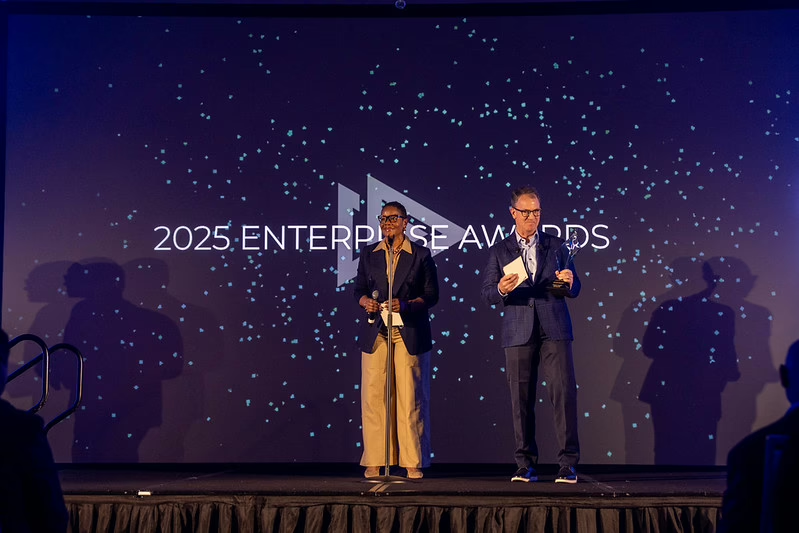
This transition marks more than a name change—it’s a modernized vision that better reflects the diverse, interconnected ecosystem powering innovation across the region. From early-stage startups to established market leaders, the PACT Ecosystem Awards celebrate the full continuum of organizations driving economic impact, discovery, and growth.
Recent insights from the U.S. Chamber of Commerce and Brookings highlight that the strongest regional economies thrive when small, mid-market, and enterprise organizations collaborate within a unified innovation pipeline. The PACT Ecosystem Awards are designed to honor that full spectrum.
Why the Evolution? A Name That Reflects Today’s Innovation Community
The shift from Enterprise Awards to PACT Ecosystem Awards comes after thoughtful dialogue with members and stakeholders. While “enterprise” often connotes large-scale organizations, today’s innovation community includes a far wider range of companies at different stages.
The new name better represents the dynamic, cross-sector nature of Greater Philadelphia’s tech, healthcare, and life sciences ecosystem. It allows us to honor not only corporate leaders, but also:
- Emerging startups building breakthrough technologies
- High-growth scaleups expanding nationally
- Corporate innovators strengthening regional competitiveness
- Life sciences pioneers advancing global research
- Healthcare changemakers improving patient outcomes
- Investors and capital partners fueling sustainable growth
A Renewed Event Experience for 2026
While the awards program is evolving, PACT remains committed to delivering the exceptional experience the community expects. Please join us at the ceremony on May 19, 2026 for:
- A refreshed event design
- New storytelling elements throughout the ceremony
- Updated and newly added award categories
- More opportunities for founders, investors, and leaders to connect
Venue Highlight: Springfield Country Club
We’re excited to continue our long-standing partnership with Springfield Country Club, known for its service, hospitality, and ability to host hundreds of regional leaders. The familiar venue will feature new programming, updated experiences, an enhanced menu, and a few surprises—alongside the fan-favorite elements our community loves.
Inside the 2026 Award Categories
Applications for the 2026 PACT Ecosystem Awards open December 8, 2025. This year’s categories recognize impact at every stage of growth:
Technology Startup Company of the Year
Criteria:
- Founded, launched meaningful operations, or pivoted between Jan 1, 2020 – Dec 31, 2025
- HQ or significant operations in the region, with leadership and team presence locally
Healthcare & Life Sciences Startup Company of the Year
Criteria:
- Founded or pivoted between Jan 1, 2020 – Dec 31, 2025
- HQ or major regional presence with key leadership in the region
Technology Emerging Growth Company of the Year
Criteria:
- $3M–$50M ARR or TTM revenue
- If projected revenue exceeds $50M in 2025, companies should apply for Technology Company of the Year
Healthcare & Life Sciences Growth Company of the Year
Criteria:
- Operates within segments such as biotech, medtech, health tech, diagnostics, therapeutics, and instrumentation
- If revenue-producing: minimum $3M ARR or TTM
- If clinical-stage: must have demonstrated human proof-of-concept
Transaction of the Year (Exit, Investment, Partnerships, M&A)
Criteria:
- Deal executed between Nov 1, 2024 – Dec 31, 2025
- Includes IPO, capital raise, buy-side or sell-side M&A
- Requires HQ or significant regional presence
Technology Company of the Year
Criteria:
- More than $50M ARR or TTM revenue
- HQ or major operations in the region
Healthcare & Life Sciences Company of the Year
Criteria:
- Operates within key life sciences and healthcare categories
- If revenue-producing: minimum $50M ARR or TTM
- If clinical-stage: must be in advanced clinical studies, ideally across multiple products
- Regional HQ or significant operations required
Join Us in Celebrating the Region’s Future
The launch of The PACT Ecosystem Awards opens a new chapter for Greater Philadelphia—one that elevates more voices, highlights more innovation stories, and continues our legacy of recognizing the companies shaping our region’s economic future.
Whether you’re a founder, investor, executive, or community builder, now is the time to participate in the growth and momentum of our innovation ecosystem.
Interested in sponsoring The PACT Ecosystem Awards?
Email Jen Devor at jdevor@philadelphiapact.com to explore sponsorship opportunities.
Want to be part of the region’s innovation future?
Join PACT as a member and engage with the leaders shaping Greater Philadelphia’s tech, healthcare, and life sciences landscape.
Learn more ways on how you can get connected to companies, thought leaders, and business networking.
Learn about PACT Membership and see upcoming events for investors and entrepreneurs in technology, healthcare, and life sciences. Plus – get on PACT’s newsletter to stay connected with the latest resources!
The post The PACT Ecosystem Awards: A New Era for Greater Philadelphia’s Innovation Community appeared first on Philadelphia Alliance for Capital & Technologies (PACT).
PACT is Hiring: Manager, Entrepreneurial Programs 18 Nov 1:01 PM (last month)
At PACT, we’re entering an exciting new chapter—one that builds on decades of impact while modernizing how we support the region’s thriving innovation ecosystem. Our organization is grounded in collaboration, curiosity, and a deep commitment to serving the founders, technologists, investors, and leaders who power Greater Philadelphia’s growth.
As part of our evolution, we’re streamlining internal systems, embracing AI to operate more efficiently, and strengthening programs that deliver real value to emerging companies. At the heart of this work is Mentor Connect, our award-winning partnership with Ben Franklin Technology Partners SEPA and a flagship program supporting early-stage entrepreneurs.
To support the next phase of this program’s growth, PACT is seeking a Manager of Entrepreneurial Programs—a key role responsible for leading Mentor Connect and expanding our suite of founder-focused initiatives.
If you love connecting with entrepreneurs, excel at building trusted relationships, and thrive in a role where technology, systems-thinking, and community engagement intersect, this may be the opportunity for you.
About the Role
Search Date: November 2025
Position: Manager, Entrepreneurial Programs
Reports to: Vice President, Business Development & Operations
Status: Full-Time, Exempt
Salary: $70,000 + benefits
The Manager, Entrepreneurial Programs will lead PACT’s mentorship and founder-support initiatives—including Mentor Connect, a global-model program created in partnership with MIT and Ben Franklin Technology Partners SEPA. This role blends program strategy, community building, marketing support, and data-driven evaluation. You will help shape the experience for hundreds of entrepreneurs and mentors while strengthening PACT’s position as the region’s go-to resource for startup growth.
About PACT
The Philadelphia Alliance for Capital and Technologies (PACT) is the region’s premier resource for emerging growth companies. We serve as a catalyst for innovation, investment, and collaboration—connecting entrepreneurs with the people and resources they need to thrive.
What You’ll Lead & Support
Lead
- Mentor Connect
- MACC Presenting Company Recruitment & Selection
- Lessons Learned entrepreneurial programming
Support
- Additional pitch competitions and entrepreneurial events
- Acquisition and renewal of PACT’s entrepreneur-level members
Key Responsibilities
Program Leadership
- Lead all aspects of Mentor Connect—including design, recruitment, onboarding, event production, and impact evaluation.
- Produce 2–3 annual Lessons Learned events for founders and mentors.
- Develop new programs and services that support early-stage entrepreneurs across the region.
- Build systems to track engagement, satisfaction, and performance using CRM databases, analytics tools, and Excel.
- Integrate AI and automation to streamline administration, improve match-making, and generate insights.
- Support entrepreneurial participation across PACT’s signature events: MACC, Enterprise Awards, and Top Pitch.
Partnership & Relationship Management
- Serve as the primary liaison to Ben Franklin Technology Partners SEPA.
- Recruit, train, and support mentors while guiding mentees through goal-setting and progress milestones.
- Build relationships with entrepreneurs, investors, corporate partners, and ecosystem organizations.
- Collaborate with PACT’s membership team to attract and retain entrepreneur-level members.
Program Operations & Reporting
- Manage budgets, deliverables, and timelines.
- Track KPIs and deliver regular impact reports.
- Ensure compliance with sponsor and grant requirements.
- Prepare data-driven presentations and share program success stories.
Marketing & Communications
- Partner with Marketing to develop storytelling campaigns, social content, and newsletter updates.
- Contribute content that highlights founder wins and Mentor Connect milestones.
- Represent PACT at ecosystem events, panels, and entrepreneurial forums.
Ideal Qualifications
- 4–6 years of experience in program or event management (entrepreneurship or innovation experience strongly preferred).
- Strong program design, execution, and evaluation skills.
- Proficiency with Excel, CRM/database systems (GrowthZone and Traction5 a plus).
- Comfort with AI tools, automation workflows, and emerging technology.
- Exceptional communication and relationship-building skills.
- Strong analytical and strategic thinking abilities.
- Highly organized, proactive, and able to manage multiple priorities.
- Professional presence and interpersonal savvy across diverse stakeholders.
- Ability to work independently while contributing to a collaborative team dynamic.
- Willingness to travel within the region and occasionally work outside standard business hours.
How to Apply
*Note: Applications are now closed as of December 15.
Submit your resume and responses to the following three questions (300 words max each) to jdevor@philadelphiapact.com with the subject line:
Manager, Entrepreneurial Programs Application
Application Questions:
- What excites you about the opportunity to grow PACT’s entrepreneur membership base and support the entrepreneurial ecosystem in Philadelphia?
- PACT values smart systems, data-driven decision making, and responsible use of AI. Share an example of how you’ve used a tool or workflow to streamline a process or strengthen a program.
- Tell us about a time you contributed to a high-performing team. What role did you play in maintaining a positive team dynamic?
Additional Information
Every position at PACT requires certain physical capabilities. Reasonable accommodations will be made to enable individuals with disabilities to perform essential job duties. The responsibilities listed are not exhaustive; as business needs evolve, additional duties may be assigned.
PACT is an equal opportunity employer, committed to a workplace rooted in dignity, respect, and nondiscrimination.
Learn more ways on how you can get connected to companies, thought leaders, and business networking.
Learn about PACT Membership and see upcoming events for investors and entrepreneurs in technology, healthcare, and life sciences. Plus – get on PACT’s newsletter to stay connected with the latest resources!
The post PACT is Hiring: Manager, Entrepreneurial Programs appeared first on Philadelphia Alliance for Capital & Technologies (PACT).
Cybersecurity moves beyond IT: Protecting your bottom line 7 Nov 8:04 AM (last month)
By Jeff Olejnik
For years, cybersecurity was considered a technical matter managed by IT. Today, that perspective is outdated and risky. Cyberthreats now directly affect your company’s financial health, valuation, operations and reputation. From cash flow and insurance costs to client trust and regulatory compliance, the consequences reach far beyond technology.
The evolving threat landscape
Cyber incidents are increasingly targeting mid-market organizations, drawn by valuable data and assets but limited security resources. What was once a minor inconvenience can now result in:
- Ransomware: Disrupting access and demanding large payments.
- Business email compromise: Leading to fraudulent transactions or impersonation.
- Data breaches: Exposing sensitive information, triggering lawsuits or fines.
- Operational downtime: Interrupting production and services for extended periods.
These are not hypothetical risks; they are real financial events, especially in today’s uncertain economy.
Cybersecurity: A strategic risk management tool
Investments in insurance, legal reviews and audits are standard for managing enterprise risk. Cybersecurity should be viewed similarly—as a core strategy for mitigating financial exposure. Major impacts from cyber events often arise outside IT, including:
- Legal and regulatory penalties.
- Lost revenue from outages or reputation damage.
- Executive time spent on crisis response.
- Customer attrition and contract losses.
- Breaches of loan agreements due to reporting delays.
- M&A valuation impacts.
Excluding cyber from risk and continuity planning leaves organizations exposed to significant costs.
Finance leaders: Essential partners in cyber strategy
Despite the financial implications, many CFOs and finance teams are only involved after a cyber incident occurs. This needs to change. Finance should participate in:
- Budgeting: Funding not just tools, but training, backup and recovery.
- Modeling impact: Assessing breach scenarios and insurance gaps.
- Risk evaluation: Setting risk appetite and tolerance.
- Metrics and reporting: Linking cyber posture to business outcomes.
- Build versus outsource decisions: Ensuring strategy aligns with cost and risk.
Cybersecurity is now integral to financial stewardship — decisions and data must be connected.
Bridging the CFO-CIO divide
Cybersecurity discussions often falter between technical and executive teams. IT leaders may advocate for upgrades, but without the context of business outcomes, their proposals can struggle to gain traction. Finance and operations leaders, focused on costs and margins, may see cybersecurity as just another expense.
CFOs don’t need deep technical expertise, but they should understand:
- Which systems and data are vital to operations.
- Where vulnerabilities exist (remote access, vendor portals, financial processes).
- What risk scenarios and response plans are in place.
- Recovery timelines and costs.
- Relevant compliance requirements.
Aligning cybersecurity with financial and operational planning allows businesses to shift from being reactive to building resilience.
Cyber risk in boardrooms and transactions
Cybersecurity posture is now a key part of audits, financing, and M&A due diligence. Buyers and investors expect:
- Documented policies and incident plans.
- Access controls and data protection.
- Employee training on threats.
- Business continuity plans that include cyber scenarios.
- Adequate insurance coverage.
- Regulatory compliance.
Lacking these can slow deals, reduce valuations or end negotiations. In other words, cyber risk isn’t just operational. It’s reputational, financial and strategic. In a deal-driven market, readiness creates leverage.
The changing cyber insurance market
Cyber insurance is no longer a simple safety net. Premiums are rising, applications are more demanding, and coverage may be denied without basic controls. Finance leaders should:
- Know what policies cover —and what they don’t.
- Collaborate with IT to meet security requirements.
- Understand retention and response obligations.
- Review policies as risks evolve.
Insurance is a tool, not a solution — it only works if foundational security is in place.
Proactive steps for business and finance leaders
To strengthen cyber risk management:
- Identify critical assets: Focus protection on systems and data that would cause major financial disruption if compromised. Use penetration testing and simulations to assess exposure. These exercises help assess both the likelihood and the severity of a breach.
- Test incident response: Run tabletop exercises to reveal gaps in communication, coordination and recovery.
- Quantify risk: Work with your IT and insurance partners to estimate the cost of different cyber scenarios — including downtime, recovery and lost business. Then, commit to a continuous improvement cycle by developing actionable mitigation plans that reduce risk to acceptable levels.
- Integrate cyber into enterprise risk: Include cybersecurity in risk dashboards and planning cycles. Confirm that risk tolerances are reviewed by leadership, not just IT.
- Keep cyber hygiene top of mind: Make security a leadership priority, with clear metrics and regular reporting. Lead by example on access controls, phishing response and software compliance. Create dashboards to track and report on the health of your cyber program over time.
Visibility drives control
Without a clear understanding of cybersecurity, organizations remain vulnerable — not just in systems, but in finances and continuity. Resilience comes from knowing your risks, testing your response and investing wisely.
At Wipfli, we help mid-market businesses close the gap between cyber awareness and action, integrating security into strategy, planning and operations. Explore our risk advisory and cybersecurity resources to learn more.
Learn more ways on how you can get connected to companies, thought leaders, and business networking.
Learn about PACT Membership and see upcoming events for investors and entrepreneurs in technology, healthcare, and life sciences. Plus – get on PACT’s newsletter to stay connected with the latest resources!
The post Cybersecurity moves beyond IT: Protecting your bottom line appeared first on Philadelphia Alliance for Capital & Technologies (PACT).
Innovation and Investment Shine at PACT’s 2025 Mid-Atlantic Capital Conference 4 Nov 7:47 AM (last month)
Philadelphia, PA — November 3, 2025
By Jen Devor
The Philadelphia Alliance for Capital & Technologies (PACT) once again united the region’s most visionary founders and investors for the 2025 Mid-Atlantic Capital Conference (MACC) — also known as Cap Con. Hosted by Blank Rome LLP on October 29–30, 2025, this year’s event spotlighted innovation, connection, and the future of growth in the Mid-Atlantic startup and investment ecosystem.
More than 750 attendees came together for two days of dealmaking, discovery, and dynamic conversation at the Philadelphia Marriott Downtown, featuring 65+ presenting companies and a powerhouse lineup of investors, executives, and entrepreneurs.

 View event photos by Greg Wright of Wright Eye Visuals →
Philadelphia Innovation on Full Display
The celebration began with PACT Fest at Reading Terminal Market, setting the tone for connection and collaboration in true Philadelphia style. The following day delivered a full schedule of company presentations, one-on-one investor meetings, and networking across technology, healthcare, and life sciences sectors.
Two keynote sessions headlined the conference in recognition of Philadelphia’s 250th anniversary of the Armed Forces:
- Jeff Eggers, Co-Founder and Managing Partner of Rsquared Ventures and retired U.S. Navy SEAL, shared lessons on leadership and resilience—from the battlefield to the boardroom.
- Bernard (Bernie) Banks, Director of Rice University’s Doerr Institute for New Leaders and retired U.S. Army Brigadier General, offered insights on building transformative leaders and organizational growth.
The day concluded with the conference’s signature finale — the Lion’s Den — where select startups pitched live to top investors for real investment commitments.
The Lion’s Den: Live Investment and Big Wins
The 11th annual Lion’s Den brought another round of excitement and tangible outcomes, with all three pitching companies — Kognition AI, Layermor, and SynchLabs — receiving on-stage investment commitments (subject to due diligence).
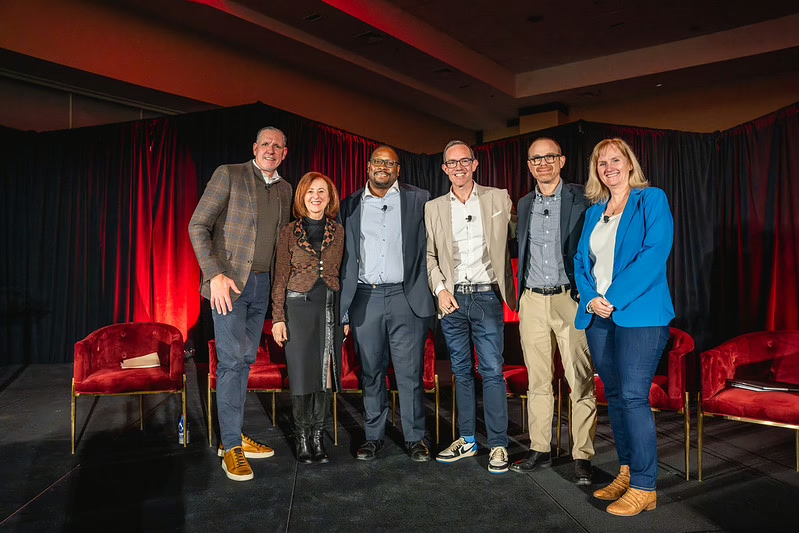
2025 Lions included:
- Kathleen Brunner (Acumen Analytics; Broad Street Angels)
- Patrick Cozzi (Cesium; Bentley Systems)
- Dan Goldsmith (Tendo; Proof Point Capital)
- Jon Gosier (Audigent; Film Hedge)
- Brenda Kurnik (Robinhood Ventures)

On-Stage Investments:
- SynchLabs, led by CEO Melanie Herbert, secured $175,000 from Cozzi, Goldsmith, and Kurnik.
- Layermor, led by CEO Ella Whalestedt, secured $150,000 from Brunner and Cozzi.
- Kognition AI, led by CEO Matias Klein, secured $50,000 from Gosier.
Special thanks to RSM and Cozen O’Connor, sponsors of the Lion’s Den, for providing both financial support and in-kind due-diligence services.
Voices of Leadership
“The Mid-Atlantic Capital Conference continues to be the ultimate platform for connecting entrepreneurs with the capital, community, and confidence they need to scale,” said Dean Miller, President of PACT. “This year’s energy and collaboration prove that Philadelphia’s and the Mid-Atlantic’s innovation ecosystems are thriving.”
“The success of this year’s conference reflects the strength of our region’s network,” added Jen Devor, Vice President of Business Development & Operations at PACT. “These connections go beyond investment—they fuel lasting partnerships that drive growth.”
Thank You to Our 2025 Sponsors
PACT extends heartfelt appreciation to the partners and organizations that make this event possible:
Activate Venture Partners • Aquiline Partners • Baker Tilly • Ballard Spahr • Bank of America • Ben Franklin Technology Partners • BioAdvance • Blank Rome LLP • Broad Street Angels • BullPen Capital • CBIZ • Centri Business Consulting • CFGI • Comcast • Cozen O’Connor • Darco Capital • Deloitte • DLA Piper • Duane Morris LLP • EisnerAmper • Entrepreneurial Operating Systems (EOS) • Exelon PECO • EY • Fairmount Partners • FirsTrust Bank • Fox Rothschild LLP • Fulton Bank • Gabriel Investments • G-Squared Partners • Hamilton Lane • Independence Blue Cross • Innovation Space • Innovation Works • JP Morgan • Juno Capital Partners • Klehr Harrison Harvey Branzburg • KPMG LLP • Morgan, Lewis & Bockius LLP • MVP Capital • Nouveau Capital • NewSpring Capital • Osage Partners • Penn Center for Innovation • Penn Engineering • Pennsylvania Biotechnology Center • PlainSight Capital • Royer Cooper Cohen & Braunfeld • RSM • SEI • Seminal Capital Partners • Silicon Valley Bank • SRI Capital • Stephano Slack LLC • Stout Risius Ross • Susquehanna Growth Equity • Temple University • TriNet • Troutman Pepper Locke • University City Science Center • Vanguard • Zer0 to 5ive
About PACT
The Philadelphia Alliance for Capital & Technologies (PACT) is the region’s leading resource for entrepreneurs, investors, and innovators. PACT connects members to capital, coaching, and customers, accelerating business growth and strengthening Philadelphia’s position as a hub for technology, healthcare, and life sciences innovation.
Learn more at philadelphiapact.com.
Learn more ways on how you can get connected to companies, thought leaders, and business networking.
Learn about PACT Membership and see upcoming events for investors and entrepreneurs in technology, healthcare, and life sciences. Plus – get on PACT’s newsletter to stay connected with the latest resources!
The post Innovation and Investment Shine at PACT’s 2025 Mid-Atlantic Capital Conference appeared first on Philadelphia Alliance for Capital & Technologies (PACT).
Businesses facing financial pressure should choose smart over fast 3 Oct 11:26 AM (2 months ago)
Today’s business climate is defined by uncertainty. Facing tariffs and a fast-evolving regulatory environment, many business leaders feel the need to respond with swift, decisive action.
Action is a good thing. But while speed does matter, it’s even more important that when you act, you do so with a clear sense of your direction based on accurate data and thoughtful scenario modeling from your finance team. Otherwise, you risk making reactive, short-term choices that will ultimately harm your organization’s long-term health.
As you consider your strategy heading into 2026, here’s what you should keep in mind.
1. Slower decisions beat flying blind
The fastest decision may not be the best one. Before you start making any big calls, you need to understand where your cash is going, what’s helping or hurting your profitability and what your financial projections look like under worst, middle and best-case scenarios.
If you don’t have cash flow visibility and financial modeling, you risk flying blind. That’s especially likely for mid-market businesses, as many companies still rely on disconnected systems, manual reports and lagging indicators.
To navigate uncertainty, the future matters more than the past. What happened last quarter is less important than what could happen if a key customer leaves, product demand shifts or interest rates go up.
In other words, you need to consider what big strategic decisions could mean for your finances before you make them.
2. Pressure reveals cracks in your systems
When money is pouring in, you probably won’t notice flaws in your systems. It’s only when profitability dips that you’re forced to confront how inefficiencies, delays and poor data integrity are holding your business back.
To assess the health of your systems, consider questions like:
- How much time does your team spend closing your books each month?
- Do you rely on spreadsheets to run what-if scenarios or use faster, more efficient software?
- Is your team aligned on KPIs and working toward a single overarching goal?
When close cycles are too long, it’s often a symptom of deeper problems like outdated software, disconnected data sources or an overburdened finance and accounting team. In some cases, it’s all three.
Once you expose these gaps in your systems, then you can take action to fix them.
3. Clarity gives confidence
Uncertainty can feel paralyzing. Many leaders are understandably afraid of making the wrong move. But this fear can not only drive hasty action but also lead to equally damaging indecision.
Clarity, however, gives you the confidence to make wiser decisions. To get that clarity, you need to :
- Build live dashboards rather than relying on static reports.
- Integrate your ERP and CRM systems to create a unified source of truth.
- Forecast multiple future scenarios, not just the outcome you think most likely to occur.
- Get your entire leadership team aligned on shared company financial goals.
Rather than focusing your finance team on reporting on what’s already happened, flip your perspective. Your finance team should help steer decisions about what happens next.
That shift takes more than updated dashboards. It requires a mindset change across the leadership team — from viewing finance as compliance to treating it as a strategic partner.
How to make your finance team a strategic partner
In practice, how can you make your finance team more of a partner in key strategic decisions? Here are some examples to consider:
- Manufacturers should ask their finance team to work with operations to model the costs of potential supply chain delays.
- Professional services firms can use finance teams to model project staffing against margin goals for smarter resourcing decisions.
- SaaS companies could try linking customer churn data to revenue forecasting, to avoid being blindsided by subscription losses.
Regardless of your sector, also consider steps like:
- Outsourcing reconciliations, close and other transactional tasks to free up your internal bandwidth.
- Upgrading your tech stack to integrate your ERP, CRM and FP&A platforms.
- Upskilling your finance team to do more financial modeling rather than just compliance and reporting.
An empowered finance team is a catalyst that helps your leadership move faster and smarter. This sort of insight-driven action will typically lead to both improved outcomes and less risk.
4. Better visibility is also a competitive advantage
Choppy financial seas may make you want hunker down. But investing in better visibility now will give you a competitive advantage — because other businesses in your market are likely focused on waiting for the storm to pass.
Consider how two different example firms approach an economic downturn:
- Company A decides to turn to cost-cutting in the face of a tough economy. It lays off people from the sales team and slashes marketing spend — only to realize, too late, just how badly those cuts will reduce pipeline volume.
- Company B takes a more thoughtful approach and runs multiple models before deciding how to act. Based on those models, it’s leadership that they can reduce go-to-market spend by 20% and still protect their growth targets.
Which one of those two companies would you rather be? Firms with better visibility:
- Invest smarter bymaking capital decisions based on maximizing ROI.
- Cut more effectively by knowing the difference between critical and nonessential spending.
- Adapt faster by acting based on facts rather than fear.
By basing decisions off of data and analytics gleaned from a single source of truth, mid-market companies can replace guesswork with intelligence. This helps leaders focus on what matters most — even when the pressure is high.
Where should you start?
If your business is feeling financial pressure, here’s how to start giving your team the visibility you need to make smarter decisions:
- Inventory your reports: Are they forward-looking or backward-looking?
- Map your systems: Are finance, operations and sales working from the same data?
- Run a scenario: If you see a sudden 15% revenue dip, what does that mean for your cash flow?
- Ask your finance team: What tools do they need to provide real-time insights?
You don’t have to fix everything at once. Start with the data you have, then build from there.
How Wipfli can help
Get the visibility you need to make smarter business decisions. Ask us to assess your needs, upgrade your systems and even take day-to-day financial work off your plate to help you turn pressure into clarity. Start a conversation.
Learn more ways on how you can get connected to companies, thought leaders, and business networking.
Learn about PACT Membership and see upcoming events for investors and entrepreneurs in technology, healthcare, and life sciences. Plus – get on PACT’s newsletter to stay connected with the latest resources!
The post Businesses facing financial pressure should choose smart over fast appeared first on Philadelphia Alliance for Capital & Technologies (PACT).
Building the Future of Work: Key Takeaways from the 2025 Apprenti National Apprenticeship & Workforce Summit 9 Sep 1:59 PM (3 months ago)
By Dean Miller, President & CEO, Philadelphia Alliance for Capital and Technologies (PACT)
Two weeks ago, I had the privilege of joining leaders from across the country at the 2025 Apprenti National Apprenticeship & Workforce Summit in Atlanta, GA. The energy in the room confirmed what we already know here in Philadelphia: registered apprenticeships are one of the most powerful tools we have to expand access to high-quality careers, close talent gaps, and future-proof our workforce.
As the nation’s leading registered apprenticeship organization focused on non-traditional roles, Apprenti is proving that apprenticeships aren’t just for the trades anymore. They are fueling opportunity and innovation in technology, life sciences, and human resources—fields that are at the heart of Philadelphia’s economy and PACT’s mission.

Pictured: PACT’s Apprenti PHL team (right to left: Dan Weagle, Zoe Carrillo, Dean Miller, and Becky DeMatteis).
6 Key Takeaways from the 2025 Apprenti Summit
1. Momentum is Growing for Registered Apprenticeships
From tech to biotech, employers are turning to apprenticeships as a scalable, cost-effective strategy to fill critical roles. Apprenti is leading this movement, placing over 6,500 apprentices with a few hundred employers across all 50 states in just the past decade.
2. PACT & Boomi are Leading the Way Locally
Here in our region, Boomi is setting a strong example as a local employer championing the apprenticeship model. Their investment is paving new pathways for diverse talent to enter the tech sector.
3. Apprenticeships Deliver for Employers
Apprenti’s retention rate speaks for itself: more than 80% of apprentices stay with their employer post-program—significantly higher than the industry average. For companies navigating constant talent churn, apprenticeships are proving to be good business.
4. Apprenticeships Change Lives
The average Apprenti apprentice is 32 years old, and each can expect to see a lifetime earnings improvement of more than $1.5 million. Collectively, that’s over $4.5 billion in added earnings across all participants. Apprenticeships don’t just create jobs—they create upward mobility.
5. Industry Leaders Are Committed
The summit featured insights from major employers including Amazon, Capital One, Accenture, Merck, CGI, and more. Their involvement demonstrates the growing cross-industry confidence in the apprenticeship model.
6. AI Skills Are Built Into the Curriculum
Recognizing the rapid pace of change, Apprenti has integrated artificial intelligence training into all apprenticeship pathways, ensuring participants graduate with future-ready skills.
Spotlight: Boomi Apprentices Share Their Journeys
In Philadelphia, we’re especially proud of the apprentices building their careers at Boomi through Apprenti and PACT. Their stories highlight the power of apprenticeships to create meaningful, lasting change:
- Abrar Jaigirdar: “This experience has given me both confidence and a clear direction for my future in tech.”
- Jessica Clay: “The RTI portion of the apprenticeship allowed me to build foundational skills, and now I’m ready to contribute as a software developer.”
- Davonta Wallace: “Working as a DevOps Apprentice has challenged me to grow, set goals, and apply new knowledge in real-world settings.”
These voices remind us that apprenticeships aren’t abstract workforce strategies—they are life-changing opportunities.
Why Apprenticeships Matter for Philadelphia’s Tech Ecosystem
At PACT, our mission is to connect capital, technology, and talent to drive growth in the Philadelphia region. Apprenticeships are central to that mission. By partnering with organizations like Apprenti, we’re helping ensure our companies have the skilled workforce they need while giving individuals equitable access to careers in STEM, life sciences, and healthcare technology.
Looking Ahead
The future of work will demand flexibility, inclusivity, and innovation. Apprenticeships are at the intersection of all three. PACT is proud to champion this model and to work alongside Apprenti, Boomi, and our community partners to ensure Philadelphia continues to grow as a hub for talent development and workforce innovation.
Interested in starting a registered apprenticeship?
Learn more ways on how you can get connected to companies, thought leaders, and business networking.
Learn about PACT Membership and see upcoming events for investors and entrepreneurs in technology, healthcare, and life sciences. Plus – get on PACT’s newsletter to stay connected with the latest resources!
The post Building the Future of Work: Key Takeaways from the 2025 Apprenti National Apprenticeship & Workforce Summit appeared first on Philadelphia Alliance for Capital & Technologies (PACT).
How did the OBBB change Section 174 R&D deductions? 3 Sep 1:37 PM (3 months ago)
After passing both houses of Congress by a narrow vote, President Trump signed the One Big Beautiful Bill (OBBB) Act on July 4, 2025. In addition to its sweeping domestic policy shifts, the law modifies the tax code in significant ways that may affect how you do business.
One key change affects taxpayers who were required, under Section 174, to capitalize and amortize research and experimental (R&E) costs. Beginning with tax year 2025, taxpayers can now get relief for domestic Section 174 costs for both prior unamortized costs and any current-year costs.
Here are more of the specifics on what’s different.
Current domestic R&E expenditures are now immediately deductible
Post-OBBB, IRC Section 174(a) allows taxpayers to immediately deduct domestic R&E expenses paid or incurred in tax years starting in 2025. This is a permanent change to the law.
- Section 174 tax treatment also goes back to the Section 174(a) and (b) options that existed prior to the 2017 Tax Cuts and Jobs Act (TCJA). Under this change, you can choose between either fully deducting your Section 174 R&E expenditures or capitalizing and amortizing R&E expenditures over a period of not less than 60 months.
- If you do elect to capitalize and amortize, your choice applies to all subsequent taxable years, not just to the taxable year in which the election is made.
- Immediately deducting domestic R&E expenditures may feel like an easy choice. However, talk with your tax advisor before making your final decision, as capitalizing and amortizing domestic R&D expenditures may serve you better in certain situations, such as if you pay the alternative minimum tax.
Requirements for overseas R&E expenditure deductions have not changed
The TCJA established 15-year capitalization and amortization requirements relating to foreign R&E expenses under Section 174(a). The OBBB leaves these untouched.
- Continuing to require that taxpayers amortize foreign R&E expenses incentivizes businesses to do research with other U.S.-based companies.
- The new law makes specific reference to the link between software development and Section 174 R&E costs. It states that “amounts paid or incurred in connection with the development of any software shall be treated as R&E expenditures.”
- If your business is involved in both U.S.-based and overseas software development, you should keep records that account for your development costs based on location in order to meet Section 174 requirements.
Certain unamortized past domestic R&E costs are now deductible
You may also now be able to recover unamortized domestic R&E expenses. The OBBB provides that if you incurred domestic R&E expenditures after December 31, 2021, and before January 1, 2025, you will be allowed to deduct any remaining unamortized domestic R&E expenditures over a one- or two-year period, starting in 2025.
- Be aware that the IRS has not yet issued procedural guidance specifying how taxpayers should implement this new rule. Consult with your tax advisor here.
- This provision only affects domestic R&E expenditures. Any foreign R&E expenses incurred between 2022-2024 will need to continue amortization, per rules established by the TCJA.
Small businesses face retroactive deduction requirements
For tax years beginning in 2022, small business taxpayers should usually be able to retroactively deduct previously capitalized, domestic Section 174 expenses. This may be a useful tool for small business owners who meet key requirements.
- Section 174(a) provides that small business taxpayers must have average annual gross receipts of $31 million or less. This limit is based on average annual gross receipts for the three preceding tax years, related to the first taxable year beginning after December 31, 2024.
- If you qualify, you have a one-year deadline from the date the bill was enacted to file an amended return in order to retroactively deduct these costs.
- The IRS still needs to issue implementation guidance for this change.
- Small business taxpayers can recover unamortized, Section 174 R&E expenditures via more than one pathway. If you qualify, you can pursue a one- or two-year recovery (usually on your 2025 or 2026 tax returns). But you also have the option to file an amended return (including corporate and shareholder returns) for each affected taxable year.
- Consult your tax advisor to determine which approach makes more sense. In many cases, you may want to take advantage of the immediate deductibility for tax year 2025, which does not require an amended return.
How else have R&E tax rules changed post-OBBB?
The OBBB leaves R&D credit requirements essentially untouched. However, the relationship between Section 280C(c) and the Section 41 R&D credit has been affected in a way that appears similar to rules established prior to the TCJA.
- You have the option to claim the gross credit and reduce domestic R&E deductions and capitalized amounts by the amount of the R&D credit. However, you can also choose to claim the net credit (which is the gross credit reduced by the maximum tax rate) instead.
- Starting in tax year 2025, the R&D credit does become more taxpayer-friendly. This is because the current-year credit benefit is no longer overshadowed by domestic Section 174 capitalization.
- The new law includes certain provisions that affect short-year returns beginning after December 31, 2024, and ending before the enactment of the bill. If impacted, consult with your tax advisor for guidance here.
- Be aware that some states may change their own tax laws as a result of the OBBB, as happened after the TCJA passed.
How Wipfli can help
The right tax strategy can help your business thrive. Ask Wipfli to help you take advantage of changing tax laws to create an approach that minimizes your tax burden. Start a conversation here.
Learn more ways on how you can get connected to companies, thought leaders, and business networking.
Learn about PACT Membership and see upcoming events for investors and entrepreneurs in technology, healthcare, and life sciences. Plus – get on PACT’s newsletter to stay connected with the latest resources!
The post How did the OBBB change Section 174 R&D deductions? appeared first on Philadelphia Alliance for Capital & Technologies (PACT).
When the Rules Change, Leaders Pivot. Is Your Healthtech Ready? 19 Aug 10:03 AM (4 months ago)
By: Karen Johnston
Healthtech in a Time of Change
The healthtech sector — from early-stage innovators to established device makers — continues to be one of the most dynamic corners of the industry. Investment interest remains high, but new waves of federal regulatory change and policy shifts are shaping the environment in which companies operate.
PACT members and partners need to be asking how healthtech leaders can keep momentum, protect value and position their organizations for long-term success in an unpredictable environment.
Every moment of change is an opportunity to reset and reorient around business, mission and customer outcomes. Instead of letting uncertainty stall progress, forward-thinking companies use it as a moment to fine-tune their approach and act with precision.
Three Critical Areas for Healthtech Leaders to Watch
1. Rising Expectations for Data Security and Risk Management
In late 2024, the U.S. Department of Health and Human Services (HHS) proposed updates to the HIPAA Security Rule that would require more formal risk management and enhanced data protection, including:
- Mandatory encryption of all electronic protected health information (ePHI), both in transit and at rest.
- Multifactor authentication for system access to prevent unauthorized breaches.
- Annual risk assessments and vulnerability scans to identify and mitigate threats.
- Network segmentation to isolate sensitive systems and reduce exposure during cyberattacks.
- Elimination of “addressable” safeguards — all security controls would be required.
Even though the final form of the rule is still in question, these updates point to a broader trend of stricter security requirements for handling health data.
Action steps for healthtech leaders:
- Conduct a gap analysis against the proposed requirements.
- Update risk assessments and documentation practices.
- Inventory all technology assets and create data maps for ePHI flows.
- Review vendor contracts for security compliance.
- Budget for potential upgrades and staff training.
2. Shifts in FDA Structure and Policy Direction
Changes in FDA leadership have set the stage for policy and administrative reforms. The agency is restructuring internally, and the incoming commissioner has highlighted a commitment to streamlining internal processes and reducing administrative delays.
FDA developments include:
- Staff reduction announced in April 2025, across a range of administrative and policy roles.
- Shift of policy development to HHS, reducing FDA autonomy in issuing guidance.
- A temporary freeze on pending FDA rules until the new commissioner takes seat.
- Anticipated deregulation, creating uncertainty about which rules apply moving forward.
Action steps for healthtech leaders:
- Build longer regulatory timelines into product roadmaps.
- Strengthen internal compliance expertise.
- Maintain open lines of communication with FDA staff.
- Keep thorough internal documentation for every stage of development.
For companies in digital therapeutics, AI diagnostics, and novel devices, staying engaged with regulators and actively contributing to policy discussions can help shape a clearer path to market.
3. Cascading Effects of New Medicaid Requirements
Recent Medicaid policy changes could lead to millions losing coverage over the next decade, which, in turn, reduces demand for reimbursable digital health services. This is a call to diversify for companies serving Medicaid or ACA exchange populations.
The cascading effects of Medicaid requirements include:
- More frequent tracking of work hours, exemptions, and renewals.
- Stricter documentation rules increasing data exchange and verification burdens.
- Higher patient copays and new rules reducing patient access, engagement, and adherence.
In today’s cost-conscious environment, healthtech leaders should focus on digital solutions that create measurable value and outcomes.
Action steps for healthtech leaders:
- Reassess payer mix and evaluate how cuts will affect margins.
- Demonstrate ROI to show customers how solutions reduce cost, improve outcomes or support care coordination.
- Support alternative payment models by aligning with ACOs, bundled payments or home-based care initiatives.
- Invest in interoperability to integrate tools into existing workflows.
Financial Levers to Fuel Growth
Amid the policy noise, there are also real financial advantages available to healthtech firms:
- 100% bonus depreciation on qualifying capital investments, retroactive to January 2025.
- Expanded Section 179 expensing for qualifying assets, helping small and midsized firms free up capital.
- Full R&D expensing restored, reclaiming deductions for software development, AI training, and clinical trials.
Adaptability as a Competitive Advantage
For PACT’s Healthtech community, adaptability is a competitive advantage. The companies that thrive will be those that can pivot quickly, deepen relationships across the healthcare ecosystem and remain laser-focused on delivering value to providers, payers and patients. Let Wipfli help. Learn more about our services for Healthtech companies.
Learn more ways on how you can get connected to companies, thought leaders, and business networking.
Learn about PACT Membership and see upcoming events for investors and entrepreneurs in technology, healthcare, and life sciences. Plus – get on PACT’s newsletter to stay connected with the latest resources!
The post When the Rules Change, Leaders Pivot. Is Your Healthtech Ready? appeared first on Philadelphia Alliance for Capital & Technologies (PACT).