Enjoying the holidays, Michigan? Or sick of your family already?
Either way, we have just what the doctor ordered — The Bridge Michigan News Quiz, 10 questions that go great with a-wassailing.
You know what comes next: Score 100%, hark the heralds and email a screenshot of your perfection to jkurth@bridgemi.com. The first to do so wins amazing Bridge swag. All who do so will be honored in next week’s quiz.
As they say around this time at the North Pole, let’s get back to work!
Look at the winners. Look at them!
Big cheers for the following readers who scored 100% on last week’s quiz: James H., Betty W., Nancy H., Sonia V., Joy M., Cheryl F., Laura M., Kim E., Vince L., Jim D., Bob K., Maryanna N., David L., Keith E., Laurie C., Sherry R., Julie E., Michael T., Greg F., Mike F., Glenn R., Bernard H. and Sharon H.
LANSING – Want insights into what’s on the mind of the citizenry?
Just listen.
One way for policymakers to find out is to pay attention to what people say during the public comment period at local government sessions.
That’s what researchers from the University of Michigan and Washington University in St. Louis explored, drawing on recordings of 259 meetings of 15 city councils around the state for a full year.
The communities ranged in population from the largest – Sterling Heights, Ann Arbor and Lansing – to the smallest: Pleasant Ridge, Cedar Springs and Williamston. Among the other cities in the study were Saline, Alpena and Jackson.
“City council meetings are vital sites for civic participation where the public can speak directly to their local government,” their new study said. “By addressing city officials and calling on them to take action, public commenters can potentially influence policy decisions spanning a broad range of concerns, from housing to sustainability to social justice.”
The cities range in per capita income – from $22,420 a year in Inkster to $84,370 in Pleasant Ridge – and in median age – from 25.9 in Ann Arbor to 48.2 in Lathrup Village. They vary in partisan voting and racial makeup as well.
The researchers’ computer analysis of recordings archived on city YouTube channels in 2023 disclosed “a rich and varied landscape of public concerns.”
Sabina Tomkins, an assistant professor of information at U-M and a study co-author, said “We saw active participation across a range of issues.”
The analysis found that the largest share of comments related to local “place-based” concerns about governance, such as policing, housing and zoning.
Second in frequency were comments on broader social concerns about the well-being of groups and individuals but not directly connected to city government, such as affordability, homelessness and public health, it said.
And some comments crossed into both categories.
Tomkins said, “People are able to span both those bases in a single comment.”
“We were really interested in how often people talk about these social concerns,” such as the Black Lives Matter movement, “and bring it back to local projects in their communities,” she said.
Sabina Tomkins is an assistant professor of information at the University of Michigan. (Courtesy of University of Michigan)
The research team found geographic variations in what participants wanted to talk about.
For example, the study said, “Comments in some of the larger cities mention societal concerns more often than smaller cities.” And while housing was the second-most common local concern overall, the subject was “barely mentioned, if at all,” in some cities, including Inkster and Lathrup Village.
The analysis found little evidence that “soap boxers” – “people speaking at length without any connection or relevance to local governance” – flood the public comment periods.
“The majority of the time, participants commented on concrete local concerns or on societal concerns which they wanted more government action and accountability around,” the study said.
Tomkins said the technology used to collect and analyze comments may provide useful information that assists journalists in covering their communities better.
“We know local news helps considerably in holding public officials accountable,” including deterring corruption, Tomkins said.
And journalists “ideally can use transcripts not to replace, but to supplement, local news without having to go to public meetings themselves,” she said.
The study is under review by an academic journal.
Top 10 societal concerns at public comment periods
Death doulas assist individuals and families navigate the various challenges in dying
Many point to an end-of-life care crisis in Michigan, as the state’s population ages
Many older residents in the state have done little to prepare for long-term health care, according to the University of Michigan
YPSILANTI — Kimberly Wamba realized what she wanted to do with her life in watching members of her family die.
She always had a desire to help people, a desire that started in childhood watching her grandmother work as an aide.
“My grandma used to go to different clients’ homes and take care of them,” Wamba told Bridge Michigan. “I really admired what she did.”
Wamba would earn a doctorate in information technology. But she took on a new role when her father got sick, returning to Michigan to help ease him through his “threshold of death” as he succumbed to illness.
“The very day of his death, I was able to be at his bedside, and I was able to hold him and look directly into his eyes,” Wamba said. “While I didn’t know anything about being a doula at that time, that experience stuck with me.”
Her father’s death led Wamba toward her work as a death doula — a wide-ranging, usually non-medical role that assists individuals and their families navigate dying — joining a small, but growing number of people in Michigan and nationally who have pursued roles in providing “death care.” The goal, Wamba said, is to fix a “broken” system of services for people at the end of their life.
Kimberly Wamba became her grandmother’s companion at the end of her life. ‘I was also able to listen to her wishes, things that she wanted us to be aware of before she transitioned,’ Wamba said. (Courtesy of Kimberly Wamba)
“For me, being a death doula is basically like somebody who walks with someone during that process of moving through transition, whether that be at the time when they’re closest to death, or even quite a bit before than,” Wamba explained.
Now the president and founder of the Metro Detroit-based non-profit Sacred Life Care Initiative, Wamba is able to work with those at a critical juncture between life and death.
Wamba, who lives in Canton, generally focuses on clients in hospice who are closer to the end of their lives, acting as a “companion” for those who want to talk about their last moments.
That work came full circle when she became her grandmother’s death doula.
In the last months of her life, the two shared meals and spent nights together. Other times, when other relatives were “dog tired” from providing the day-to-day care, Wamba said she was present for deep introspection and conversation.
“I was also able to listen to her wishes, things that she wanted us to be aware of before she transitioned,” Wamba said. “She could talk through those things with me, and there would be a level of acceptance to be able to hold that space in a specific way that it might have been harder for sometimes her children to hold space for.”
Kimberly Wamba (right), president and founder of the Metro Detroit-based non-profit Sacred Life Care Initiative, works as a death doula to address Michigan’s end-of-life care ‘crisis.’ (Courtesy of Kimberly Wamba)
A ‘gigantic spectrum’ of deathcare
Death doulas operate as a “spiritual, emotional support” role, according to Hanna Hasselschwert of Acacia End of Life Services in Ypsilanti.
“We don’t have control of our death, typically, but we do have a lot of things that we can control — what happens to our bodies and decisions that are made when we’re gone,” said Hasselschwert.
Death doulas, also referred to as death midwives or end-of-life doulas, exist on a “gigantic spectrum,” Hasselschwert said. Sometimes the work is administrative, assisting families in finding the proper resources for estate planning or funeral arrangements. Other times, the work is focused on providing comfort for clients undergoing end-of-life palliative care.
Hasselschwert focuses on advanced planning, helping her clients navigate medical directives and estate logistics and how those details get communicated to families. She also helped launch the Michigan Deathcare Collaborative, a directory for “alternative, holistic deathcare” in Michigan, where she estimates about 50 death doulas operate.
As part of her work, Hasselschwert hosts a twice-monthly “Death Cafe” meet-up at coffee shops to normalize conversations about confronting death and grief.
“Death is gonna happen. Talking about it doesn’t make it more likely,” said Melissa Chapman, a frequent Death Cafe participant and aspiring doula. “If somebody’s pregnant … they learn about kids and about what pregnancy is like and how it works. It’s a very similar thing.”
Many at the cafe spend their time recounting their personal experience with family members and friends who have died, or “pre-grieving” those battling terminal disease and the difficulty they find engaging others about mortality.
Hanna Hasselschwert facilitates a group discussion during a ‘Death Cafe’ in Ypsilanti, Dec. 21, 2025 (Eli Newman / Bridge Michigan)
Tommy Cook discovered the Ypsilanti Death Cafe after a friend died by suicide.
“Growing up, a lot of father figures were taken out of my life. Both my grandparents and then my dad as a senior in high school,” Cook said. “Grief, for me, always continues where it left off.”
Being present for difficult conversations about loss keeps Cook returning to the Death Cafe. “What we’ve all been through is really brutal,” he said. “I feel like it’d be good if we all got training on how to be a death doula and how to be able to hold space for people grieving.”
Hasselschwert, who works part-time at a fitness studio, said it’s difficult for death doulas to make a full-time job of their positions, given the individual capacity for providing services and emotional tax the work has.
“We do this out of just our passion, our care. So most doulas work off a sliding scale,” she said.
There’s no formal license to become a death doula, but programs around the country provide assistance. In 2024, the National End-of-Life Doula Alliance reported its membership had grown to over 1,600 up from about 250 in 2019.
Both Hasselschwert and Wamba trained through the organization Going with Grace, which educates death doulas across the country through webinars and group studies. Alua Arthur, Going with Grace’s founder, explained her role as a death doula in a 2023 Ted Talk.
“My goal is to help them answer the question: ‘What must I do to be at peace with myself so that I may live presently and die gracefully, holding both at the same time?’”
Only 25% of residents over 50 have designated a durable power of attorney for medical care and 58% incorrectly believe Medicare will pay for nursing home care, according to the U-M poll. 46% of state residents 50 to 64 and 39% of those over 65 say they have not discussed future health care plans with anyone.
Wamba said her organization is trying to address Michigan’s lack of end-of-life services, aiming to provide her services free-of-charge using alternative funding and donations.
Tommy Cook meets with a group at a ‘Death Cafe’ meeting in Ypsilanti. ‘What we’ve all been through is really brutal,’ Cook said. “I feel like it’d be good if we all got training on how to be a death doula and how to be able to hold space for people grieving.” (Eli Newman / Bridge Michigan)
“We’ve got so many more people that are moving into that space and needing the care,” she said. “We also have this huge gap, though, of people who can’t afford to have someone come in for $30 an hour to give 24-hour care to their loved ones.”
Confronting death is something Chapman had already done before attending the Ypsilanti Death Cafe sessions — she had a “gut-wrenching” experience taking care of her father as he died.
But his death has given her perspective about what to expect at the end.
“Life is not all about longevity. It’s all about quality,” Chapman said. “We’re all not going to get out of here alive.”
Michigan’s Natural Resources Commission made decisions on underwater spearfishing, turkey hunting and more
The Michigan Department of Natural Resources indefinitely paused a controversial goose-gassing program
The NRC has not yet decided what to do about the length of the coyote hunting season
In 2025, Michigan expanded underwater spearfishing, simplified turkey hunting and changed who can kill a buck, but the state has yet to make a final decision on what to do about coyotes.
Michigan’s hunting and fishing rules are decided by the Natural Resources Commission. The group is made up of seven governor-appointed members who hold monthly public meetings. While orders related to hunting and fishing regulations are often researched and written by Michigan Department of Natural Resources staff, the Natural Resources Commission ultimately votes on them.
This year, the NRC approved a number of significant policy changes and still has a couple outstanding issues to settle in 2026.
Here’s a look at some of the biggest changes of the year:
Underwater spearfishing expanded
Underwater spearfishing advocates say Michigan approved the biggest North American expansion for freshwater gamefish that the sport has ever seen.
Since 2022, those who partake in the sport have been allowed to go after three kinds of desirable gamefish — lake trout, northern pike and walleye — but only in limited areas of Lake Michigan and Lake Huron. Underwater spearfishing participants argued that wasn’t fair because they buy the same fishing license as hook-and-line anglers.
In November, the Natural Resources Commission voted to let underwater spearfishers go after those fish in additional waters: parts of Lake Erie and Lake Superior and expanded portions of Lake Michigan. Those changes will go into effect in April.
Liberty and Independence hunt participants can now shoot a buck
Michigan’s Liberty and Independence hunts are available to youth 16 and younger, veterans and people with disabilities outside of the regular deer seasons. After changes made last year, hunters in those seasons were supposed to only be able to take antlerless deer starting this year. But in May, the Natural Resources Commission changed it so participants could each kill an antlerless deer or a buck.
“If they had a buck, we didn’t want them to have to pass on it because there are so few bucks taken during that season,” said Natural Resources Commission Chair Becky Humphries.
“They changed a lot for Turkey,” said Justin Tomei, the former policy and government affairs manager for Michigan United Conservation Clubs. “I think the hunters are going to be pretty happy with the way it turned out.”
The number of regulated zones (which are called turkey management units) were drastically reduced for both spring and fall turkey seasons. For the fall, the license process was also streamlined and new areas in the northern Lower Peninsula were made available for hunting. For the spring, the season was also extended, opportunities were expanded for youth and hunters were required to report their kills.
Michigan paused its newest goose-killing program
Since 2022, the DNR had allowed property owners or park staff to apply to have Canada geese killed if they threatened human health or safety.
The Michigan Department of Natural Resources indefinitely paused a controversial goose-gassing program this year. (Joel Kurth/Bridge Michigan)
In September of last year, the practice gained more visibility when the NRC voted to implement an expanded program that would have allowed some lake associations, golf clubs, municipalities and others to hire federal crews to round up and gas geese.
Locations seeking to participate would have needed to be involved in the state’s nest and egg destruction program and have at least 100 geese on their property or geese that were threatening human health or safety.
The new program, which was set to start in June, resulted in public outcry, including a billboard that said, “Tell Gov Whitmer Don’t Gas Geese!”
In May, DNR Director Scott Bowen announced he had indefinitely paused the controversial geese-gassing effort.
Commission closer to weighing in on coyote season
One decision that wasn’t made in 2025 was what to do about coyotes.
The length of the coyote hunting season has been a hot topic since it was shortened to nine months in March of last year. Some hunting and trapping groups felt like that decision wasn’t based on science. They sued.
Sign up for our outdoors newsletter
Want more coverage like this delivered directly into your inbox? Sign up for the Bridge Michigan Outdoors newsletter here.
Earlier this year, in March, the NRC introduced an amendment to extend the coyote hunting season, but it didn’t vote on it. Then in June, a judge ruled on the lawsuit, saying the commission’s decision to shorten the coyote season was sound.
At the Natural Resources Commission’s December meeting, an informational DNR memo said the commission is looking to allow coyotes to be killed year-round by dividing regulations into two areas: a hunting and trapping season, and a coyote management season. The commission is expected to take up the issue again in January.
LANSING – There are currently 2,149 inmates aged 65 or older in the state, accounting for 6.7% of the state’s total prison population of 32,265, according to data from Jenni Riehle, the public information officer for the Department of Corrections.
“Our population is aging because when you come to prison in Michigan, you tend to stay longer periods of time,” said Heidi Washington, the director of the department.
The department has observed an upward trend in the average minimum sentence imposed by judges, rising from just two years two decades ago to the current five years, according to Washington.
Washington said that the longer sentences lead to the aging population build up.
Riehle said that aging inmates need more medical services than younger populations, increasing the need for accessible facilities and equipment such as wheelchairs and specialized systems for hearing-impaired inmates. Those may incur additional costs for the department.
Prisons also provide courses and educational placements for individuals serving life sentences and indeterminate sentences as part of a strategic program for inmates.
The results are good, according to Washington.
“People who are in prison for a long time also need to have constructive things to be doing, things that help them work on their own selves and their plan for the future,” Washington said.
To address the aging of the population resulting from long-term incarceration, Sen. Stephanie Chang, D-Detroit, is promoting legislative changes.
She has introduced the Second Look Sentencing Act which would allow judges to review the sentences of nonviolent inmates who have already served at least 10 years. The legislation has not been passed.
Chang, who chairs the Senate Committee on Civil Rights, Judiciary and Public Safety, said, “Some people have been in prison for many decades. They’re now just very different people. They’ve changed themselves.
“Maybe they don’t need to be there any more,” Chang said.
Real Christmas trees can be recycled into mulch, wildlife habitats, and garden uses
Many communities offer curbside pickup or drop-off sites for tree recycling
Experts warn not to linger: leaving a tree too long or burning it indoors is dangerous
If you went the real-tree route this Christmas, there are several ways to put those fragrant evergreens to use after the holiday season. They can be recycled into mulch, wildlife habitats and other useful things.
Artificial trees, on the other hand, usually stick around longer than you’d like: made from polyvinyl chloride, a plastic that can’t be recycled, they often end up in landfills, according to the National Christmas Tree Association.
Real trees — stripped of lights, tinsel and other adornments — can be recycled and repurposed for different things.
Some towns offer curbside pickup for Christmas trees, while others let residents drop them off at designated recycling sites. You can see if your area participates by checking the Michigan Department of Environment, Great Lakes, and Energy’s recycling directory.
Nationally, the website Earth911 has a searchable database—just enter “Christmas tree” and your ZIP code. Certain Home Depot locations also accept trees for recycling, so it’s worth calling your local store.
Christmas tree scraps
DIY enthusiasts and backyard gardeners have ways to put trees to use.
The best option is probably to put your tree out on the curb so crews can turn it into mulch and bark for the next year, Bill Lindberg, a Christmas tree expert with MSU Extension, told Bridge Michigan.
The branches also help with regulating plants’ temperature as the weather fluctuates, which can increase the chances of them surviving the winter.
In some neighborhoods, you might be able to place your tree outside for wildlife to nibble on and let it naturally decompose.
Keep in mind, though, that while animals like goats and alpacas often enjoy Christmas trees, some farms and zoos won’t accept them due to possible pesticide or chemical treatments.
“The thing we would want to avoid, from an environmental standpoint, is putting it in a landfill,” Lindberg said. “That would just cause more methane production.”
If your community doesn’t recycle Christmas trees or you can’t find a site to take them near you, it might be worth calling a Christmas tree farm, because some also recycle trees for their customers.
Don’t wait, don’t burn
Leaving the tree up for an extended time is not recommended. The National Fire Protection Association says trees should be removed from the home promptly after Christmas or if they are dried out. Don’t leave them inside the home, garage or place them outside against the house.
It’s not safe to toss your Christmas tree into the fireplace. Real trees are highly flammable, and burning them indoors can quickly lead to an uncontrollable fire. They also contribute to creosote buildup in chimneys, increasing the risk of a chimney fire. On top of that, pine needles release nitrogen and terpenes, which produce toxic fumes when burned.
“You do not want to burn it in your fireplace; that’s a bad idea. But, if you have a burn bucket outside, you can absolutely burn it,” said Amy Start, executive director of the Michigan Christmas Tree Association. “You have to be really careful when you burn anything. It’s the end of the season, so it’ll be a little bit more dry.”
Before burning a Christmas tree outdoors, check local laws and follow safety guidelines.
“Be creative and figure out a way to just recycle it,” she said.
President Donald Trump’s first year in office has ushered in big changes for clean energy in Michigan
The state has seen $540 million in canceled climate grants and a dramatic decrease in green energy-related investments
Analysts expect the trend to continue as shifting federal policies prompt a renewed embrace of gas-powered vehicles and fossil fuel energy generation
What a difference a year (and a political leadership change) makes.
At this time in 2024, Michigan was expecting a windfall of federal funds to fuel a transition to clean energy, along with billions of dollars’ worth of green manufacturing projects subsidized by the Biden administration’s signature climate spending bills.
But since President Donald Trump began his second term in January and began scrapping federal climate programs he refers to collectively as “the green new scam,” Michigan has seen a wave of project and grant cancellations, along with renewed investment in fossil fuel-based manufacturing and power generation.
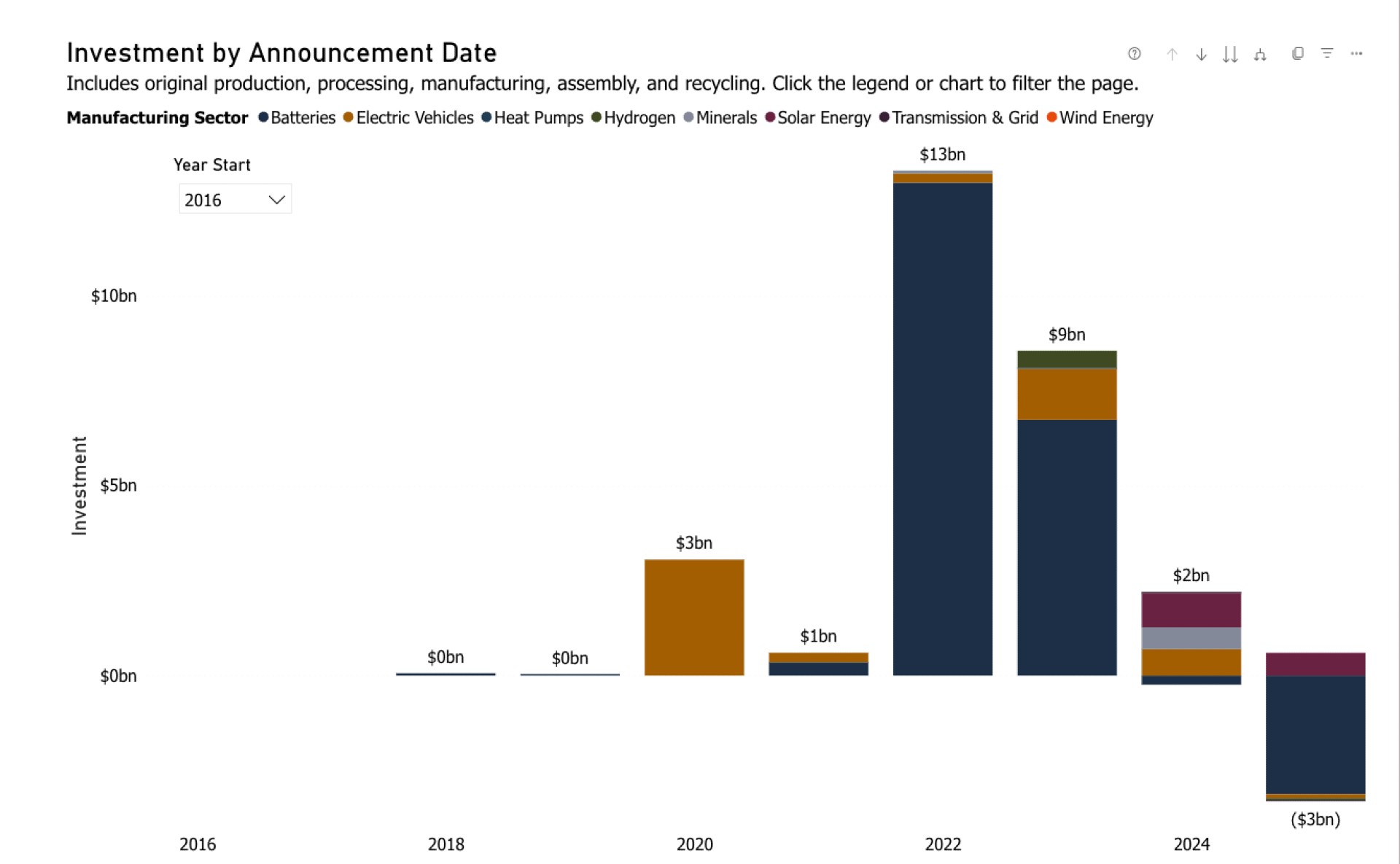
Roughly $540 million in climate-related grants to Michigan have been canceled or held up since Inauguration Day, according to a national database compiled by Atlas Public Policy, while shifting market forces and the end of federal tax credits for electric vehicles have caused clean manufacturing investments in Michigan to whipsaw from billions annually in recent years to $3 billion in canceled investments this year.
“It certainly mirrors what we’re seeing nationally,” said Annabelle Rosser, a research analyst with the national firm.
Instead, Michigan automakers are scaling back and refocusing on gas and hybrid vehicle production — a trend emblemized by Ford’s and General Motors’ recent decisions to scrap EV production plans at Michigan plants and retool to produce gas-powered vehicles.
“That’s just the way the market is shaking out right now,” said Glenn Stevens, executive director of MichAuto, an affiliate of the Detroit Regional Chamber.
It’s a trend likely to continue into 2026, as Trump administration officials continue their efforts to downplay climate change, deemphasize renewable energy and embrace fossil fuels.
Here’s where things stand in Michigan as the year draws to a close:
Michigan has seen $540 million in cancelled funding, with the biggest chunk coming from the Solar for All Program, a $7 billion US Environmental Protection Agency fund meant to expand solar energy in disadvantaged communities.
Michigan had been slated to receive a $156 million grant through that fund, while Native American tribes in the state were expecting part of a $62 million grant shared with other Great Lakes tribes. Michigan Attorney General Dana Nessel has sued over the grant cancellations, joining 22 other states to argue the administration “unilaterally and illegally terminated” the program, overstepping checks and balances to cancel congressionally approved funding.
Beyond the solar program, the federal government has cancelled or proposed to cancel more than 20 Michigan grants ranging from $31.7 million to help LuxWall Inc. build an energy-efficient window glass factory in Detroit to $14,000 for a west Michigan climate resilience project.
Other canceled grants include:
$28.2 million for TS Conductor to build a high-capacity power line plant in Erie
$20.4 million for Ecoworks, a Detroit nonprofit that planned to convert houses of worship into climate resilience hubs
$20 million for the Southwestern Michigan Planning Commission to build two resilience hubs in Benton Harbor, upgrade energy efficiency in low-income housing and support a workforce development initiative
Smaller grants would have funded energy efficient housing in Kalamazoo, a climate change and resilience plan for the city of Flint and wild rice bed restoration in Michigan waterways.
The Trump administration has also frozen a $20 billion federal “green bank” network that had been expected to send hundreds of millions of dollars to Michigan to build and rehab housing across the state, insulate old homes and boost energy efficiency in factories.
Trump officials have signaled that more cancellations could be coming as they review tens of billions of dollars in clean energy funds awarded by the previous administration.
Michigan utilities, for example, are awaiting word on the status of $15 billion in clean energy-related loans announced days before Trump took office. And the Trump administration is reevaluating a grant program that awarded $500 million to retool a Lansing GM factory for electrified vehicles.
An exception to the administration’s shift of resources away from Biden-era energy policies: It has continued making disbursements from a $1.5 billion loan authorized in 2024 to support the reopening of the Palisades nuclear power plant and in December announced another $400 million to develop two new reactors at the site.
“President Trump has made clear that America is going to build more energy, not less, and nuclear is central to that mission,” US Secretary of Energy Chris Wright said in a statement accompanying the grant announcement.
$3 billion in canceled projects
Spurred along by federal and state subsidies and regulations that encouraged automakers to build EVs and consumers to buy them, Michigan manufacturers announced a collective $23.8 billion in new investments tied to the energy transition between 2022 and 2024, mostly related to battery or EV plants.
Atlas Public Policy’s green economy tracker shows changes in green manufacturing investments in Michigan in recent years. (Courtesy of Atlas Public Policy)
Fast-forward to 2025, and the trendline has reversed. Michigan saw $3 billion worth of disinvestment this year as companies scrapped planned EV factories or closed existing ones, according to the Atlas analysis.
Spokespeople for the US Department of Energy, which has overseen efforts to reprioritize fossil fuels by shifting federal resources and loosening vehicle emissions regulations, did not respond to requests for comment from Bridge Michigan.
But Trump has routinely cast EVs as a costly “scam” while downplaying the effects of climate change caused by burning fossil fuels like gasoline. During a December announcement that his administration would loosen fuel economy standards applying to new vehicles, Trump cast his pro-gas policies as a win for consumers that would “protect American jobs” and shave “at least $1,000 off the price of a new car.”
The biggest EV-related cancellation is the Gotion project, a once-planned $2.4 billion electric vehicle battery plant near Big Rapids that spent years embroiled in controversy before state officials declared the project dead this fall.
In that case, Rosser, the Atlas analyst, said, shifting federal policies weren’t the only factor.
“The rollback of the (Inflation Reduction Act) clean energy tax credits, softening demand for electric vehicles, and concerns about the company’s foreign ownership are all likely factors,” Rosser said.
This fall, batterymaker XALT Energy announced plans to close its Midland headquarters and an Auburn Hills facility just two years after announcing plans to spend a “double digit million sum” expanding the facility.
Automotive supplier Dana Inc., which had vowed to invest $54.2 million at an Auburn Hills EV battery plant by the end of 2024, instead announced this fall that it would close the plant amid an “unexpected and immediate reduction in customer orders driven by lower demand for electric vehicles.”
Fortescue canceled an under-construction $210 million EV charger, battery and hydrogen generator plant at the former Fisher Body site in Detroit, citing shifting US markets and policies including the loss of “critical tax credits.”
Other losses included the closure of an Akasol electric vehicle battery factory in Warren and cancelled plans to build a TS Conductor high-voltage direct current conductor plant in Erie using a since-cancelled $28 million federal grant.
TS Conductor is still building the plant, but switched locations to South Carolina after receiving what company CEO Jason Huang described as a “very generous incentive package.”
Timelines and ambitions for numerous other EV and battery factory projects in Michigan have shifted amid the changing policies and market forces. GM, for instance, sold its stake in a planned EV battery factory near Lansing to LG Energy Solution and the plant’s planned opening has been delayed from 2025 to 2026. And Ford has scaled back plans for an EV battery plant near Marshall, now slated to open in 2026.
Stevens said he expects the EV market to grow in 2026, but “it’s not going to be at the acceleration curve that a lot of people projected, and certainly the previous administration was pushing.”
LANSING – Public attitudes toward wolves are split in the Upper Peninsula, a new study finds, with more than 60% of residents surveyed favoring reducing wolf abundance, motivated mostly by worry about risks to livestock, white-tailed deer and human safety.
However, those who valued the ecological role of wolves were less likely to support cutting their numbers, according to the study, “Social and Ecological Influences on Human Coexistence with Gray Wolves,” in the journal Conservation Science and Practice.
“Perceived risks, particularly to deer, strongly influenced attitudes,” the study said.
The Wolf Conservation Center, based in New York, reported that there were at least 762 wolves in the UP in 2023.
The study recommended that the Department of Natural Resources balance public concerns with management of the state’s wolf population.
In the United States, heightened perception of risks negatively impacts people’s willingness to coexist with wolves.
“People living with wolves perceive real risks that need to be attended to,” said researcher Shawn Riley, an emeritus professor in the Michigan State University Department of Fisheries and Wildlife.
Riley, the lead author of the study, said those risks are to livestock, deer populations and human health and safety.
The DNR’s management plan was most recently updated in 2022, reflecting a better understanding of wolf biology.
The plan proposes multiple approaches to promote positive interactions between people and wolves. Those include public education and fostering the ecological, cultural, economic and personal benefits from maintaining sustainable wolf populations.
To address risks, the plan suggests removing direct threats to human safety and livestock.
Non-lethal options include removing things that attract wolves and using scare devices and deterrent techniques, as well as using fencing, lighting systems and livestock-guarding animals.
The plan also supports financial compensation for livestock losses caused by wolves.
Riley said balancing local concerns with the views of people in other regions can reduce political tensions.
When those surveyed understood and appreciated the role of wolves, they were less likely to support reducing their numbers, he said.
“If there are risks to deer populations relative to what is desired, a focus on habitat management for deer rather than restricting hunter opportunities is more likely to result in greater levels of acceptance for wolves,” Riley said.
Riley also said that public participation is important in areas where residents perceive the negative impact of wolves because it ensures affected communities have a voice in the decision-making process.
“They have greater say in their lives, as opposed to situations where they perceive decisions are made without consideration for the people living with wolves,” Riley said.
“I believe these findings are relevant and applicable globally in situations where wolves coexist on rural landscapes,” Riley said.
Auto insurance rates up slightly since Michigan reforms took effect, but state report concludes changes kept costs from climbing higher
Critics contend the state’s interpretation of the data is misleading, argue drivers are paying more than they were for less coverage
Michigan is no longer considered the most expensive auto insurance in the US, though Detroit drivers still pay highest average premiums
It’s been more than six years since Michigan officials approved bipartisan reforms aimed at driving down sky-high auto insurance costs. Yet the question remains: was it a net positive for Michigan drivers?
A recent report on the law’s impact commissioned by Michigan’s Department of Insurance and Financial Services suggests it may still be too early for a victory lap, though Gov. Gretchen Whitmer and other supporters of the 2019 law lauded its findings.
Using data pulled from state records and insurance companies, the Dec. 1 report from Milliman, a Seattle-based actuarial and consulting firm, estimates that changes resulted in drivers spending an average of $357 per year less than they would have had the reforms not taken effect.
Milliman analysts attributed the bulk of those savings to new provisions allowing drivers to choose lower levels of personal injury protection as an alternative to what had been mandatory lifetime care coverage.
The 2019 legislation also cut medical provider reimbursement rates as part of a larger attempt to reduce auto insurance premium costs.
“In 2019, Democrats and Republicans in the Legislature and I came together to deliver historic, bipartisan auto insurance reform that lowered costs for Michiganders,” Whitmer said in a recent statement. “We’re still seeing the positive impact of that reform and how it’s working for Michiganders across the state.”
Michigan’s average auto insurance premium has gone up slightly since reforms took effect — but a new report commissioned by the state suggests drivers would be hundreds of dollars more now if not for the changes. (Courtesy Department of Insurance and Financial Services)
Drivers may not be noticing the distinction in their bank accounts, however.
Though there was a slight decrease in Michigan’s average per-vehicle premiums in 2021 following the COVID-19 pandemic, the report shows insurance rate hikes in 2023 and 2024 means drivers are paying roughly $200 more on insurance per car than they were in 2019.
The report’s authors suggest that pre- and post-pandemic auto insurance rates would be an apples-to-oranges comparison, instead basing their analysis on assumptions of how rates would have been adjusted for inflation and other factors under the state’s previous policy.
Longtime critics of Michigan’s auto insurance policies argue that’s a misleading way to look at the data.
“Michigan drivers pay more today for their auto insurance, with the state’s lowest income drivers bearing more burden than the report is willing to acknowledge,” Doug Heller, director of insurance at the nonprofit Consumer Federation America, said in a statement.
How Michigan’s rates compare
Since the 2019 changes, Michigan’s average auto insurance costs went from worst in the nation to…slightly less worse.
Nationwideanalyses continue to rank Michigan in the top 10 most expensive states to insure a car, though states like New York, Louisiana and Florida have since surpassed Michigan’s average premiums.
Car insurance rates have been on the rise nationwide. According to the US Bureau of Labor Statistics, the national average car insurance premium is 55% percent higher than pre-pandemic levels.
The number of people opting out of unlimited personal injury protection has steadily increased since Michigan’s auto insurance reforms took effect. (Courtesy Department of Insurance and Financial Services)
Price controls in Michigan’s 2019 auto insurance overhaul “did not make Michigan immune to the inflationary economic environment,” the Milliman report notes, though its authors added that Michigan’s average rate increase lagged behind nation’s, “which suggests that (the 2019 laws) suppressed costs and resulting rate changes during this period.”
Groups like the Insurance Alliance of Michigan — which represents the state’s major insurance providers — are taking that as a win.
“It’s important to let the reforms continue to work to drive down insurance costs and build upon the success of these important changes so we provide even more relief to Michigan drivers struggling with the high cost of everything,” Erin McDonough, executive director of the Insurance Alliance of Michigan, said in a recent statement.
Prices may vary
Statewide averages are one thing — what Michigan drivers actually pay to insure their vehicles can still vary widely.
The Milliman report found the average premium for personal injury protection coverage decreased by $369 per insured vehicle as more drivers choose lower levels of coverage. A majority of drivers still choose the unlimited coverage option, though the report determined that nearly 30% of drivers had chosen a lower coverage limit as of 2024.
Michigan’s current law goes further than most states in prohibiting insurers from setting rates based on factors like gender, marital status, home ownership, education level, occupation, zip codes or credit scores.
A person’s driving record is still taken into account, and there is no language banning insurers from using aspects of a person’s credit history to set rates. Insurers are also allowed to group auto insurance risks by territory, which some critics have said negates the ban against using zip codes to guide rates.
That dynamic hasn’t changed much in the years since Michigan overhauled its auto insurance laws.
One estimate from CarInsurance.com listed Detroit and neighboring Hamtramck as the two most expensive US cities to get auto insurance in the country, noting Detroit drivers pay as much as $1,500 per year more for auto insurance than drivers in neighboring Dearborn and $2,480 more than drivers in Warren.
What about uninsured drivers?
The Milliman report showed the estimated number of uninsured motorists in Michigan increased from 17.2% in 2019 to more than 20% in 2020. Michigan’s uninsured motorist rate has decreased slightly since then, but as of 2024 remained higher than it was pre-pandemic.
Despite the uptick, the report suggests that reforms and the state’s amnesty period for uninsured drivers to resume coverage without penalties “may have had an impact on suppressing” an increase in uninsured drivers.
Michigan’s number of uninsured drivers has gone up slightly in recent years and remains higher than the national rate, though a state-commissioned report noted the gap between the state and national rate is getting smaller. (Courtesy Department of Insurance and Financial Services)
Michigan’s rate of uninsured motorists was 5.4% higher than the national rate prior to the reforms. It is now 3.9% higher than the last known national rate.
Some lawmakers are advocating for change to bring those numbers down. A proposal from Sen. Jeff Irwin, D-Ann Arbor, that passed a Senate committee in October would permanently prevent insurers from charging a reinstatement fee or higher rates to drivers whose coverage lapsed.
Irwin said his plan would help make it easier for drivers who are having trouble making ends meet to get back into the system.
“Furthermore, all Michigan drivers pay more for these uninsured drivers,” he said in a statement. “For the sake of all drivers’ rates, we need to make it easier, not harder, to buy insurance.”
Other proposed changes
Various interest groups have lobbied — mostly unsuccessfully — to edit state auto insurance laws since their initial passage.
Crash survivors and their health providers have long argued the system is untenable, putting too many restrictions on medical expenses and slashing the amounts insurers are required to pay by as much as 45 percent.
Legislation introduced last session would have increased reimbursement rates for medical providers caring for seriously injured motorists and lifted a payment cap for care provided by family members. It got bipartisan support in the Senate, but was opposed by the Whitmer administration and didn’t gain traction in the House.
Major changes within Michigan’s energy sector are expected to dominate the environmental headlines in 2026
Michigan could see big decisions about data centers, Line 5, the Palisades nuclear plant
Here are five environmental storylines to watch
Changes to Michigan’s energy sector are expected to dominate the headlines in 2026, with big implications for the state’s environment.
From data centers, coal plants and solar arrays to petroleum pipelines and aging dams, energy-related decisions next year that could shape Michigan’s environment for decades to come, affecting everything from which fish can survive in rivers to how quickly the state’s utilities ditch planet-warming fossil fuels.
Here are the topics to watch:
Data centers
Swift and secretive dealmaking involving some of the world’s most powerful corporations.
Given those dynamics, it’s no wonder data centers became one of Michigan’s biggest environmental and political issues in 2025. And the debate shows no signs of letting up in 2026.
“It’s not going away,” said Sarah Mills, a land use planning expert at the University of Michigan who advises local officials as they consider how to respond to the data center boom.
“I’m telling you, like, two weeks ago, the priest talked about it at church.”
Tech giants OpenAI, Oracle and Related Digital expect to break ground soon on Michigan’s first hyperscale data center in Saline Township, a milestone hailed by some as a win for Michigan, and maligned by others as an example of corporations railroading communities.
Developers have approached multiple other communities with data center proposals, prompting pushback from neighbors and fears that rapid expansion of the energy and water-hungry industry could imperil Michigan’s environment and drive up utility rates.
Support and opposition blurs party lines. Data center supporters include President Donald Trump, a Republican, and Gov. Gretchen Whitmer, a Democrat. Both contend the facilities are important to state and national economic development and national security interests.
Meanwhile, bipartisan criticism has emerged in response to Michigan’s tax breaks for the industry and regulators’ approval of data center deals with limited public scrutiny. They note that the facilities employ few permanent workers and have overtaxed water and energy supplies in some other data center-heavy states.
Michigan’s two largest utilities, Consumers Energy and DTE Energy, both say they’re in late-stage negotiations to bring on several gigawatts’ worth of new data centers in the near future.
“We’re talking about doubling our entire electricity demand,” said Bryan Smigielski, a Michigan organizer with the Sierra Club. “There’s no way to do that in a sustainable manner.”
The next year will be crucial for both sides, as developers continue to pursue deals and local governments decide whether to grant them access to the land they need to operate.
Michigan’s energy transition
More than two years after state lawmakers passed a law requiring utilities to get all of their power from designated “clean” sources by 2040, Michiganders will get their first glimpse next year at how the largest utilities plan to meet that goal.
Both DTE Energy and Consumers Energy, the monopoly utilities that provide electricity to the vast majority of Michigan households, are scheduled to file so-called integrated resources plans next year with the Michigan Public Service Commission.
The long-range planning documents spell out how utilities plan to meet demand over the next 20 years. Because of the new climate law, they also must include details about how they’ll invest in clean energy to get off fossil fuels.
Both utilities contend they’re on track to meet the 2040 deadline, along with an interim deadline to reach 50% renewables by 2030.
But they have a long way to go. Right now, about 12% of Michigan’s in-state electricity generation is from renewable sources.
Concern has emerged recently that growing demand from data centers could make it harder for utilities to make the transition. A single hyperscale facility typically consumes as much power as a large American city.
And at least in the near-term, DTE Energy is planning to power the Saline Township facility largely with fossil fuel energy generated by ramping up production at existing power plants.
“We cannot build renewables fast enough to avoid at least a temporary increase in greenhouse gas emissions” from data centers, said Douglas Jester, managing partner at the energy consulting firm 5 Lakes Energy.
Over the longer term, utilities will need to build even more solar arrays, wind farms or other approved clean energy to meet rising data center demand while still complying with the state’s clean energy law. Adding a single 1 gigawatt data center to the grid would require an extra 10,000 acres of solar arrays if utilities looked to power it exclusively with solar.
That raises big questions about where that energy infrastructure might be built and how utilities will add it to a power grid that’s already facing lengthy interconnection backlogs.
Palisades power plant
Against that backdrop, the Palisades nuclear plant has emerged as a controversial answer to Michigan’s energy supply conundrum.
It seems all but certain that the shuttered facility on Michigan’s southwestern shoreline will reopen in 2026, as the federal and state governments pour money into an effort to boost Michigan’s supply of carbon-free energy during a time of rising demand.
Subsidies for the project now top $3.5 billion.
A training facility at the Palisades nuclear plant includes technology dating back to the 1970s, when the plant came online. Nuclear energy proponents want Michigan to be ground zero for an industrywide renaissance. (Kelly House/Bridge Michigan)
The federal government has authorized a $1.5 billion loan plus $1.3 billion in grants to help two rural electric cooperatives buy power from the plant and another $400 million to build additional reactors at the site. Michigan taxpayers have chipped in another $300 million.
“I’ll keep working with anyone to grow Michigan’s economy and build a more affordable, clean energy future right here in Michigan,” said Whitmer, a supporter of the restart plan.
Officials with Holtec Energy, the plant’s owner, began refueling the facility in October and say they’re on track to start generating power as soon as year’s end. But as of early December, federal officials were still inspecting the plant and opponents were fighting on multiple fronts to prevent the restart.
Arguing the promise of emissions-free energy is not worth the risk of reopening a 54-year-old plant that has a history of problems, three anti-nuclear groups filed a November lawsuit contending the restart scheme should never have received regulatory approval.
“They’re making a mockery of safety regulations and even laws,” said Kevin Kamps, a Kalamazoo-based radioactive waste specialist with Beyond Nuclear. His group will likely file additional suits if the Nuclear Regulatory Commission allows the plant to reopen.
And then there’s the issue of what to do with the spent nuclear fuel. The United States still has no permanent storage location for the stuff, so, for now, it’d be held indefinitely in storage casks situated on concrete pads near the Great Lakes shoreline.
Line 5
After years of delays, cost overruns, lawsuits and political controversy, 2026 could be the year Michigan learns for sure whether Enbridge Energy will build the Line 5 tunnel.
Federal regulators say they’ll decide by spring whether to grant key permits for the proposed concrete-lined tunnel beneath the Straits of Mackinac, where Enbridge has said since 2018 it plans to reroute the petroleum pipeline that currently poses an oil spill risk in the open water of the Straits.
But this fall, they announced they’re also studying a separate option that would involve drilling a narrow borehole hundreds of feet underground and snaking the pipeline through it.
While pipeline fans and foes await decisions on the federal permit and a separate state permit that Enbridge needs to begin tunnel construction, the US Supreme Court is preparing to issue a key ruling pertaining to Attorney General Dana Nessel’s yearslong effort to shut down the pipeline.
The court will decide which court — federal or state — should decide whether the pipeline shuts down.
It may sound insignificant, but onlookers widely agree that a state court is more likely to side with Nessel, while a federal court is more likely to side with Enbridge.
Climate change
So far, Michigan is seeing its most normal winter in years, by historic standards.
Snowpack across much of the state is at or above average, temperatures have been seasonally chilly, and a brave few are already augering fishing holes into the ice as Great Lakes bays freeze over.
Michigan has endured a string of lackluster winters, including in 2024, when the ice spire outside Gaylord City Hall was rapidly melting on an early February day. (Kelly House/Bridge Michigan)
But the respite from a string of lackluster winters and smoky, hot summers can’t mask the fact that Earth’s atmosphere is steadily warming, with consequences reverberating into the Great Lakes region’s ecosystem.
Bridge has written extensively about how climate change affects Michigan, from lost winter pastimes to disappearing fish and worsening storm damage. It’s impossible to say what sort of climate disruption is in store for Michigan in 2026, but you can bet on more coverage about how the global changes are hitting home locally.


%20calc(100vw%20-%202rem),%20(max-width:%2053rem)%20calc(8%20*%20(100vw%20/%2012)),%20(min-width:%2053rem)%20calc(6%20*%20(100vw%20/%2012)),%20100vw%22%20data-attachment-id%3D%2213149%22%20data-permalink%3D%22https://bridgemi.com/center-michigan/bridge-michigan-news-quiz-april-18-2025-another-awesome-week/attachment/news_quiz_1/%22%20data-orig-file%3D%22https://i0.wp.com/bridgemi.com/wp-content/uploads/2025/04/news_quiz_1.png?fit%3D1200%252C800%26amp;ssl%3D1%22%20data-orig-size%3D%221200,800%22%20data-comments-opened%3D%221%22%20data-image-meta%3D%22%7B%26quot;aperture%26quot;:%26quot;0%26quot;,%26quot;credit%26quot;:%26quot;%26quot;,%26quot;camera%26quot;:%26quot;%26quot;,%26quot;caption%26quot;:%26quot;%26quot;,%26quot;created_timestamp%26quot;:%26quot;0%26quot;,%26quot;copyright%26quot;:%26quot;%26quot;,%26quot;focal_length%26quot;:%26quot;0%26quot;,%26quot;iso%26quot;:%26quot;0%26quot;,%26quot;shutter_speed%26quot;:%26quot;0%26quot;,%26quot;title%26quot;:%26quot;%26quot;,%26quot;orientation%26quot;:%26quot;0%26quot;%7D%22%20data-image-title%3D%22news_quiz_1%22%20data-image-description%3D%22%22%20data-image-caption%3D%22%22%20data-medium-file%3D%22https://i0.wp.com/bridgemi.com/wp-content/uploads/2025/04/news_quiz_1.png?fit%3D300%252C200%26amp;ssl%3D1%22%20data-large-file%3D%22https://i0.wp.com/bridgemi.com/wp-content/uploads/2025/04/news_quiz_1.png?fit%3D780%252C520%26amp;ssl%3D1%22%20/%3E%3C/figure%3EHo%20ho%20ho.%20What%20do%20you%20know?%20Find%20out%20with%20the%20magnificent%20Bridge%20Michigan%20News%20Quiz.)


%20calc(100vw%20-%202rem),%20(max-width:%2053rem)%20calc(8%20*%20(100vw%20/%2012)),%20(min-width:%2053rem)%20calc(6%20*%20(100vw%20/%2012)),%20100vw%22%20data-attachment-id%3D%2270831%22%20data-permalink%3D%22https://bridgemi.com/michigan-government/wonder-what-worries-michigan-most-go-to-a-city-council-meeting/attachment/111325_megasite_town_hall_pg-scaled/%22%20data-orig-file%3D%22https://i0.wp.com/bridgemi.com/wp-content/uploads/2025/12/111325_Megasite_town_hall_PG-scaled-1.webp?fit%3D2560%252C1707%26amp;ssl%3D1%22%20data-orig-size%3D%222560,1707%22%20data-comments-opened%3D%220%22%20data-image-meta%3D%22%7B%26quot;aperture%26quot;:%26quot;0%26quot;,%26quot;credit%26quot;:%26quot;%26quot;,%26quot;camera%26quot;:%26quot;%26quot;,%26quot;caption%26quot;:%26quot;%26quot;,%26quot;created_timestamp%26quot;:%26quot;0%26quot;,%26quot;copyright%26quot;:%26quot;%26quot;,%26quot;focal_length%26quot;:%26quot;0%26quot;,%26quot;iso%26quot;:%26quot;0%26quot;,%26quot;shutter_speed%26quot;:%26quot;0%26quot;,%26quot;title%26quot;:%26quot;%26quot;,%26quot;orientation%26quot;:%26quot;0%26quot;%7D%22%20data-image-title%3D%22111325_Megasite_town_hall_PG-scaled%22%20data-image-description%3D%22%22%20data-image-caption%3D%22%26lt;p%26gt;Citizens%20gather%20at%20a%20town%20hall%20in%20Flint.%20(Paula%20Gardner/Bridge%20Michigan)%26lt;/p%26gt;%0A%22%20data-medium-file%3D%22https://i0.wp.com/bridgemi.com/wp-content/uploads/2025/12/111325_Megasite_town_hall_PG-scaled-1.webp?fit%3D300%252C200%26amp;ssl%3D1%22%20data-large-file%3D%22https://i0.wp.com/bridgemi.com/wp-content/uploads/2025/12/111325_Megasite_town_hall_PG-scaled-1.webp?fit%3D780%252C520%26amp;ssl%3D1%22%20/%3E%3C/figure%3EA%20new%20study%20from%20U-M%20finds%20most%20residents%20speaking%20at%20city%20council%20public%20comment%20periods%20in%2015%20communities%20are%20concerned%20primarily%20with%20local%20problems%20such%20as%20housing,%20public%20works%20and%20zoning,%20while%20a%20smaller%20proportion%20raise%20broader%20social%20concerns%20such%20as%20affordability,%20anti-racism%20and%20homelessness.)


%20calc(100vw%20-%202rem),%20(max-width:%2053rem)%20calc(8%20*%20(100vw%20/%2012)),%20(min-width:%2053rem)%20calc(6%20*%20(100vw%20/%2012)),%20100vw%22%20data-attachment-id%3D%2271033%22%20data-permalink%3D%22https://bridgemi.com/michigan-health-watch/michigans-death-doulas-bring-solace-to-those-navigating-the-end-of-life/attachment/deathdoula_122125_en-1/%22%20data-orig-file%3D%22https://i0.wp.com/bridgemi.com/wp-content/uploads/2025/12/DeathDoula_122125_EN-1-scaled.jpeg?fit%3D2560%252C1920%26amp;ssl%3D1%22%20data-orig-size%3D%222560,1920%22%20data-comments-opened%3D%220%22%20data-image-meta%3D%22%7B%26quot;aperture%26quot;:%26quot;2.2%26quot;,%26quot;credit%26quot;:%26quot;%26quot;,%26quot;camera%26quot;:%26quot;iPhone%2016%20Pro%26quot;,%26quot;caption%26quot;:%26quot;%26quot;,%26quot;created_timestamp%26quot;:%26quot;1766235412%26quot;,%26quot;copyright%26quot;:%26quot;%26quot;,%26quot;focal_length%26quot;:%26quot;2.2200000286119%26quot;,%26quot;iso%26quot;:%26quot;800%26quot;,%26quot;shutter_speed%26quot;:%26quot;0.016666666666667%26quot;,%26quot;title%26quot;:%26quot;%26quot;,%26quot;orientation%26quot;:%26quot;1%26quot;%7D%22%20data-image-title%3D%22DeathDoula_122125_EN%20(1)%22%20data-image-description%3D%22%22%20data-image-caption%3D%22%26lt;p%26gt;About%20a%20dozen%20people%20discuss%20death%20and%20grieving%20at%20Bridge%20Community%20Cafe%20in%20Ypsilianti%20on%20Dec.%2021.%202025.%20(Eli%20Newman%20/%20Bridge%20Michigan)%26lt;/p%26gt;%0A%22%20data-medium-file%3D%22https://i0.wp.com/bridgemi.com/wp-content/uploads/2025/12/DeathDoula_122125_EN-1-scaled.jpeg?fit%3D300%252C225%26amp;ssl%3D1%22%20data-large-file%3D%22https://i0.wp.com/bridgemi.com/wp-content/uploads/2025/12/DeathDoula_122125_EN-1-scaled.jpeg?fit%3D780%252C585%26amp;ssl%3D1%22%20/%3E%3C/figure%3EDeath%20doulas%20are%20helping%20individuals%20and%20families%20navigate%20end-of-life%20care%20amid%20what%20experts%20call%20a%20%E2%80%98crisis%E2%80%99%20in%20services%20for%20Michigan's%20aging%20population.)


%20calc(100vw%20-%202rem),%20(max-width:%2053rem)%20calc(8%20*%20(100vw%20/%2012)),%20(min-width:%2053rem)%20calc(6%20*%20(100vw%20/%2012)),%20100vw%22%20data-attachment-id%3D%2270534%22%20data-permalink%3D%22https://bridgemi.com/spearfishing1_underwater_michiganspearfishingassociation-1/%22%20data-orig-file%3D%22https://i0.wp.com/bridgemi.com/wp-content/uploads/2025/12/Spearfishing1_UnderWater_MichiganSpearfishingAssociation-1.jpg?fit%3D1920%252C1080%26amp;ssl%3D1%22%20data-orig-size%3D%221920,1080%22%20data-comments-opened%3D%220%22%20data-image-meta%3D%22%7B%26quot;aperture%26quot;:%26quot;0%26quot;,%26quot;credit%26quot;:%26quot;%26quot;,%26quot;camera%26quot;:%26quot;%26quot;,%26quot;caption%26quot;:%26quot;%26quot;,%26quot;created_timestamp%26quot;:%26quot;0%26quot;,%26quot;copyright%26quot;:%26quot;%26quot;,%26quot;focal_length%26quot;:%26quot;0%26quot;,%26quot;iso%26quot;:%26quot;0%26quot;,%26quot;shutter_speed%26quot;:%26quot;0%26quot;,%26quot;title%26quot;:%26quot;%26quot;,%26quot;orientation%26quot;:%26quot;0%26quot;%7D%22%20data-image-title%3D%22Spearfishing1_UnderWater_MichiganSpearfishingAssociation%20(1)%22%20data-image-description%3D%22%22%20data-image-caption%3D%22%26lt;p%26gt;Michigan%20expanded%20spearfishing,%20updated%20turkey%20rules%20and%20changed%20who%20can%20take%20a%20buck%20in%202025%20%E2%80%94%20but%20it%20still%20hasn%E2%80%99t%20decided%20on%20new%20coyote%20regulations.%20(Courtesy%20of%20the%20Michigan%20Spearfishing%20Association)%26lt;/p%26gt;%0A%22%20data-medium-file%3D%22https://i0.wp.com/bridgemi.com/wp-content/uploads/2025/12/Spearfishing1_UnderWater_MichiganSpearfishingAssociation-1.jpg?fit%3D300%252C169%26amp;ssl%3D1%22%20data-large-file%3D%22https://i0.wp.com/bridgemi.com/wp-content/uploads/2025/12/Spearfishing1_UnderWater_MichiganSpearfishingAssociation-1.jpg?fit%3D780%252C439%26amp;ssl%3D1%22%20/%3E%3C/figure%3EThe%20state%20ruled%20on%20a%20controversial%20goose-gassing%20program,%20underwater%20spearfishing%20and%20other%20issues,%20and%20is%20moving%20toward%20deciding%20when%20coyotes%20can%20be%20killed.)

%20calc(100vw%20-%202rem),%20(max-width:%2053rem)%20calc(8%20*%20(100vw%20/%2012)),%20(min-width:%2053rem)%20calc(6%20*%20(100vw%20/%2012)),%20100vw%22%20data-attachment-id%3D%2265097%22%20data-permalink%3D%22https://bridgemi.com/michigan-government/michigan-makes-prisoners-pay-for-doctor-visits-critics-call-it-a-costly-mistake/attachment/crime-prisoncellbars-3/%22%20data-orig-file%3D%22https://i0.wp.com/bridgemi.com/wp-content/uploads/2025/08/prison-shutterstock-1.jpg?fit%3D1200%252C900%26amp;ssl%3D1%22%20data-orig-size%3D%221200,900%22%20data-comments-opened%3D%220%22%20data-image-meta%3D%22%7B%26quot;aperture%26quot;:%26quot;0%26quot;,%26quot;credit%26quot;:%26quot;Shutterstock%26quot;,%26quot;camera%26quot;:%26quot;%26quot;,%26quot;caption%26quot;:%26quot;Crime%20-%20Prison%20Cell%20Bars%26quot;,%26quot;created_timestamp%26quot;:%26quot;0%26quot;,%26quot;copyright%26quot;:%26quot;Copyright%20(c)%202017%20Dan%20Henson/Shutterstock.%20%20No%20use%20without%20permission.%26quot;,%26quot;focal_length%26quot;:%26quot;0%26quot;,%26quot;iso%26quot;:%26quot;0%26quot;,%26quot;shutter_speed%26quot;:%26quot;0%26quot;,%26quot;title%26quot;:%26quot;Crime,-,Prison,Cell,Bars%26quot;,%26quot;orientation%26quot;:%26quot;1%26quot;%7D%22%20data-image-title%3D%22Crime,-,Prison,Cell,Bars%22%20data-image-description%3D%22%22%20data-image-caption%3D%22%26lt;p%26gt;(Photo%20via%20Shutterstock)%26lt;/p%26gt;%0A%22%20data-medium-file%3D%22https://i0.wp.com/bridgemi.com/wp-content/uploads/2025/08/prison-shutterstock-1.jpg?fit%3D300%252C225%26amp;ssl%3D1%22%20data-large-file%3D%22https://i0.wp.com/bridgemi.com/wp-content/uploads/2025/08/prison-shutterstock-1.jpg?fit%3D780%252C585%26amp;ssl%3D1%22%20/%3E%3C/figure%3EThere%20are%20more%20than%202,000%20state%20prison%20inmates%2065%20years%20or%20older.%20Officials%20say%20the%20aging%20population%20requires%20specialized%20services,%20equipment%20and%20costs.)

%20calc(100vw%20-%202rem),%20(max-width:%2053rem)%20calc(8%20*%20(100vw%20/%2012)),%20(min-width:%2053rem)%20calc(6%20*%20(100vw%20/%2012)),%20100vw%22%20data-attachment-id%3D%2270458%22%20data-permalink%3D%22https://bridgemi.com/quality-life/how-to-recycle-your-christmas-tree-safely-responsibly-in-michigan/attachment/treefarmmcta12825/%22%20data-orig-file%3D%22https://i0.wp.com/bridgemi.com/wp-content/uploads/2025/12/TreefarmMCTA12825-e1765565783105.jpg?fit%3D1280%252C720%26amp;ssl%3D1%22%20data-orig-size%3D%221280,720%22%20data-comments-opened%3D%220%22%20data-image-meta%3D%22%7B%26quot;aperture%26quot;:%26quot;0%26quot;,%26quot;credit%26quot;:%26quot;%26quot;,%26quot;camera%26quot;:%26quot;%26quot;,%26quot;caption%26quot;:%26quot;%26quot;,%26quot;created_timestamp%26quot;:%26quot;0%26quot;,%26quot;copyright%26quot;:%26quot;%26quot;,%26quot;focal_length%26quot;:%26quot;0%26quot;,%26quot;iso%26quot;:%26quot;0%26quot;,%26quot;shutter_speed%26quot;:%26quot;0%26quot;,%26quot;title%26quot;:%26quot;%26quot;,%26quot;orientation%26quot;:%26quot;1%26quot;%7D%22%20data-image-title%3D%22TreefarmMCTA12825%22%20data-image-description%3D%22%22%20data-image-caption%3D%22%26lt;p%26gt;Real%20trees%20can%20be%20recycled%20into%20mulch%20or%20wildlife%20habitats,%20while%20artificial%20trees%20usually%20end%20up%20in%20landfills.%20Experts%20say%20to%20recycle%20real%20trees%20promptly%20and%20never%20burn%20them%20indoors%20due%20to%20fire%20risks.(Courtesy%20of%20the%20Michigan%20Christmas%20Tree%20Association)%26lt;/p%26gt;%0A%22%20data-medium-file%3D%22https://i0.wp.com/bridgemi.com/wp-content/uploads/2025/12/TreefarmMCTA12825-e1765565783105.jpg?fit%3D300%252C169%26amp;ssl%3D1%22%20data-large-file%3D%22https://i0.wp.com/bridgemi.com/wp-content/uploads/2025/12/TreefarmMCTA12825-e1765565783105.jpg?fit%3D780%252C439%26amp;ssl%3D1%22%20/%3E%3C/figure%3EReal%20Christmas%20trees%20can%20be%20turned%20into%20mulch,%20wildlife%20shelters%20or%20even%20backyard%20garden%20helpers.)

%20calc(100vw%20-%202rem),%20(max-width:%2053rem)%20calc(8%20*%20(100vw%20/%2012)),%20(min-width:%2053rem)%20calc(6%20*%20(100vw%20/%2012)),%20100vw%22%20data-attachment-id%3D%2270543%22%20data-permalink%3D%22https://bridgemi.com/istock-824981622-1/%22%20data-orig-file%3D%22https://i0.wp.com/bridgemi.com/wp-content/uploads/2025/12/iStock-824981622-1.jpg?fit%3D1920%252C1080%26amp;ssl%3D1%22%20data-orig-size%3D%221920,1080%22%20data-comments-opened%3D%220%22%20data-image-meta%3D%22%7B%26quot;aperture%26quot;:%26quot;0%26quot;,%26quot;credit%26quot;:%26quot;%26quot;,%26quot;camera%26quot;:%26quot;%26quot;,%26quot;caption%26quot;:%26quot;%26quot;,%26quot;created_timestamp%26quot;:%26quot;0%26quot;,%26quot;copyright%26quot;:%26quot;%26quot;,%26quot;focal_length%26quot;:%26quot;0%26quot;,%26quot;iso%26quot;:%26quot;0%26quot;,%26quot;shutter_speed%26quot;:%26quot;0%26quot;,%26quot;title%26quot;:%26quot;%26quot;,%26quot;orientation%26quot;:%26quot;0%26quot;%7D%22%20data-image-title%3D%22iStock-824981622%20(1)%22%20data-image-description%3D%22%22%20data-image-caption%3D%22%26lt;p%26gt;More%20than%20$500%20million%20worth%20of%20Biden-era%20climate%20grants%20awarded%20to%20Michigan%20have%20been%20canceled%20since%20President%20Donald%20Trump%20took%20office.%20Among%20them,%20Michigan%20was%20slated%20to%20receive%20$156%20million%20for%20renewable%20energy%20in%20disadvantaged%20Michigan%20communities.%C2%A0%20(Photo%20via%20iStock)%26lt;/p%26gt;%0A%22%20data-medium-file%3D%22https://i0.wp.com/bridgemi.com/wp-content/uploads/2025/12/iStock-824981622-1.jpg?fit%3D300%252C169%26amp;ssl%3D1%22%20data-large-file%3D%22https://i0.wp.com/bridgemi.com/wp-content/uploads/2025/12/iStock-824981622-1.jpg?fit%3D780%252C439%26amp;ssl%3D1%22%20/%3E%3C/figure%3EAs%20the%20Trump%20administration%20deemphasizes%20green%20energy%20and%20embraces%20fossil%20fuels,%20Michigan%20has%20seen%20more%20than%20$500%20million%20in%20canceled%20federal%20climate%20grants%20while%20investment%20in%20EV%20battery%20plants%20and%20other%20green%20manufacturing%20has%20tanked.)

%20calc(100vw%20-%202rem),%20(max-width:%2053rem)%20calc(8%20*%20(100vw%20/%2012)),%20(min-width:%2053rem)%20calc(6%20*%20(100vw%20/%2012)),%20100vw%22%20data-attachment-id%3D%2270910%22%20data-permalink%3D%22https://bridgemi.com/outdoors-life/wolf-debate-rages-on-in-michigans-up/attachment/wolf-hunt-lawsuit/%22%20data-orig-file%3D%22https://i0.wp.com/bridgemi.com/wp-content/uploads/2025/12/AP24127747110339-scaled.jpg?fit%3D2560%252C1792%26amp;ssl%3D1%22%20data-orig-size%3D%222560,1792%22%20data-comments-opened%3D%220%22%20data-image-meta%3D%22%7B%26quot;aperture%26quot;:%26quot;0%26quot;,%26quot;credit%26quot;:%26quot;AP%26quot;,%26quot;camera%26quot;:%26quot;%26quot;,%26quot;caption%26quot;:%26quot;FILE%20-%20This%20photo%20provided%20by%20the%20U.S.%20Fish%20and%20Wildlife%20Service%20shows%20a%20gray%20wolf,%20April%2018,%202008.%20A%20judge%20on%20Monday,%20May%206,%202024,%20dismissed%20a%20lawsuit%20filed%20by%20animal%20welfare%20advocates%20seeking%20to%20invalidate%20Wisconsin%5Cu2019s%20new%20wolf%20management%20plan.%20(Gary%20Kramer/U.S.%20Fish%20and%20Wildlife%20Service%20via%20AP,%20File)%26quot;,%26quot;created_timestamp%26quot;:%26quot;1423717200%26quot;,%26quot;copyright%26quot;:%26quot;%26quot;,%26quot;focal_length%26quot;:%26quot;0%26quot;,%26quot;iso%26quot;:%26quot;0%26quot;,%26quot;shutter_speed%26quot;:%26quot;0%26quot;,%26quot;title%26quot;:%26quot;Wolf%20Hunt%20Lawsuit%26quot;,%26quot;orientation%26quot;:%26quot;0%26quot;%7D%22%20data-image-title%3D%22Wolf%20Hunt%20Lawsuit%22%20data-image-description%3D%22%22%20data-image-caption%3D%22%26lt;p%26gt;Wolves%20remain%20a%20lighting%20rod%20in%20Michigan%26amp;%238217;s%20UP%20(Gary%20Kramer%20/%20U.S.%20Fish%20and%20Wildlife%20Service%20via%20Associated%20Press)%26lt;/p%26gt;%0A%22%20data-medium-file%3D%22https://i0.wp.com/bridgemi.com/wp-content/uploads/2025/12/AP24127747110339-scaled.jpg?fit%3D300%252C210%26amp;ssl%3D1%22%20data-large-file%3D%22https://i0.wp.com/bridgemi.com/wp-content/uploads/2025/12/AP24127747110339-scaled.jpg?fit%3D780%252C546%26amp;ssl%3D1%22%20/%3E%3C/figure%3EPublic%20attitudes%20toward%20wolves%20are%20split%20in%20the%20Upper%20Peninsula,%20a%20new%20study%20finds.)


%20calc(100vw%20-%202rem),%20(max-width:%2053rem)%20calc(8%20*%20(100vw%20/%2012)),%20(min-width:%2053rem)%20calc(6%20*%20(100vw%20/%2012)),%20100vw%22%20data-attachment-id%3D%2270642%22%20data-permalink%3D%22https://bridgemi.com/michigan-government/did-auto-insurance-overhaul-help-michigan-motorists-depends-who-you-ask/attachment/auto-insurance-michigan/%22%20data-orig-file%3D%22https://i0.wp.com/bridgemi.com/wp-content/uploads/2025/12/AP20179456482348.jpg?fit%3D2202%252C1316%26amp;ssl%3D1%22%20data-orig-size%3D%222202,1316%22%20data-comments-opened%3D%220%22%20data-image-meta%3D%22%7B%26quot;aperture%26quot;:%26quot;0%26quot;,%26quot;credit%26quot;:%26quot;AP%26quot;,%26quot;camera%26quot;:%26quot;%26quot;,%26quot;caption%26quot;:%26quot;FILE-%20In%20a%20June%2023,%202015,%20file%20photo,%20traffic%20heads%20north%20along%20the%20Lodge%20freeway%20in%20Detroit.%20Michigan%20drivers%20will%20have%20choices%20to%20make%20when%20they%20renew%20or%20buy%20a%20new%20auto%20insurance%20policy%20under%20a%20law%20taking%20effect%20Thursday,%20July%202,%202020.%20Motorist%20can%20buy%20unlimited%20personal%20injury%20protection,%20but%20it%20will%20no%20longer%20be%20mandatory.%20(AP%20Photo/Carlos%20Osorio,%20File)%26quot;,%26quot;created_timestamp%26quot;:%26quot;1435107366%26quot;,%26quot;copyright%26quot;:%26quot;Copyright%202019%20The%20Associated%20Press.%20All%20rights%20reserved.%26quot;,%26quot;focal_length%26quot;:%26quot;0%26quot;,%26quot;iso%26quot;:%26quot;0%26quot;,%26quot;shutter_speed%26quot;:%26quot;0%26quot;,%26quot;title%26quot;:%26quot;Auto%20Insurance%20Michigan%26quot;,%26quot;orientation%26quot;:%26quot;1%26quot;%7D%22%20data-image-title%3D%22Auto%20Insurance%20Michigan%22%20data-image-description%3D%22%22%20data-image-caption%3D%22%26lt;p%26gt;Michigan%20lawmakers%20overhauled%20the%20state%26amp;%238217;s%20auto%20insurance%20laws%20in%202019%20in%20an%20attempt%20to%20save%20motorists%20money.%20(Carlos%20Osorio/Associated%20Press)%26lt;/p%26gt;%0A%22%20data-medium-file%3D%22https://i0.wp.com/bridgemi.com/wp-content/uploads/2025/12/AP20179456482348.jpg?fit%3D300%252C179%26amp;ssl%3D1%22%20data-large-file%3D%22https://i0.wp.com/bridgemi.com/wp-content/uploads/2025/12/AP20179456482348.jpg?fit%3D780%252C466%26amp;ssl%3D1%22%20/%3E%3C/figure%3EMichiganders%20are%20saving%20an%20average%20of%20$357%20on%20auto%20insurance%20because%20of%202019%20reforms,%20according%20to%20one%20new%20analysis.%20Critics%20say%20the%20study%20doesn%E2%80%99t%20show%20the%20full%20picture.)


%20calc(100vw%20-%202rem),%20(max-width:%2053rem)%20calc(8%20*%20(100vw%20/%2012)),%20(min-width:%2053rem)%20calc(6%20*%20(100vw%20/%2012)),%20100vw%22%20data-attachment-id%3D%2270560%22%20data-permalink%3D%22https://bridgemi.com/img_1637-1/%22%20data-orig-file%3D%22https://i0.wp.com/bridgemi.com/wp-content/uploads/2025/12/IMG_1637-1.jpg?fit%3D1920%252C1080%26amp;ssl%3D1%22%20data-orig-size%3D%221920,1080%22%20data-comments-opened%3D%220%22%20data-image-meta%3D%22%7B%26quot;aperture%26quot;:%26quot;0%26quot;,%26quot;credit%26quot;:%26quot;%26quot;,%26quot;camera%26quot;:%26quot;%26quot;,%26quot;caption%26quot;:%26quot;%26quot;,%26quot;created_timestamp%26quot;:%26quot;0%26quot;,%26quot;copyright%26quot;:%26quot;%26quot;,%26quot;focal_length%26quot;:%26quot;0%26quot;,%26quot;iso%26quot;:%26quot;0%26quot;,%26quot;shutter_speed%26quot;:%26quot;0%26quot;,%26quot;title%26quot;:%26quot;%26quot;,%26quot;orientation%26quot;:%26quot;0%26quot;%7D%22%20data-image-title%3D%22IMG_1637%20(1)%22%20data-image-description%3D%22%22%20data-image-caption%3D%22%26lt;p%26gt;Michigan%E2%80%99s%20ongoing%20data%20center%20debate%20shows%20no%20sign%20of%20letting%20up.%20Dueling%20lawn%20signs%20reveal%20the%20tensions%20between%20neighbors.%20(Joel%20Kurth/Bridge%20Michigan)%26lt;/p%26gt;%0A%22%20data-medium-file%3D%22https://i0.wp.com/bridgemi.com/wp-content/uploads/2025/12/IMG_1637-1.jpg?fit%3D300%252C169%26amp;ssl%3D1%22%20data-large-file%3D%22https://i0.wp.com/bridgemi.com/wp-content/uploads/2025/12/IMG_1637-1.jpg?fit%3D780%252C439%26amp;ssl%3D1%22%20/%3E%3C/figure%3EFrom%20data%20centers%20to%20nuclear%20plants,%20Michigan%20will%20see%20some%20big%20energy-related%20decisions%20next%20year%20that%20could%20shape%20the%20state%E2%80%99s%20environment%20for%20decades%20to%20come.)